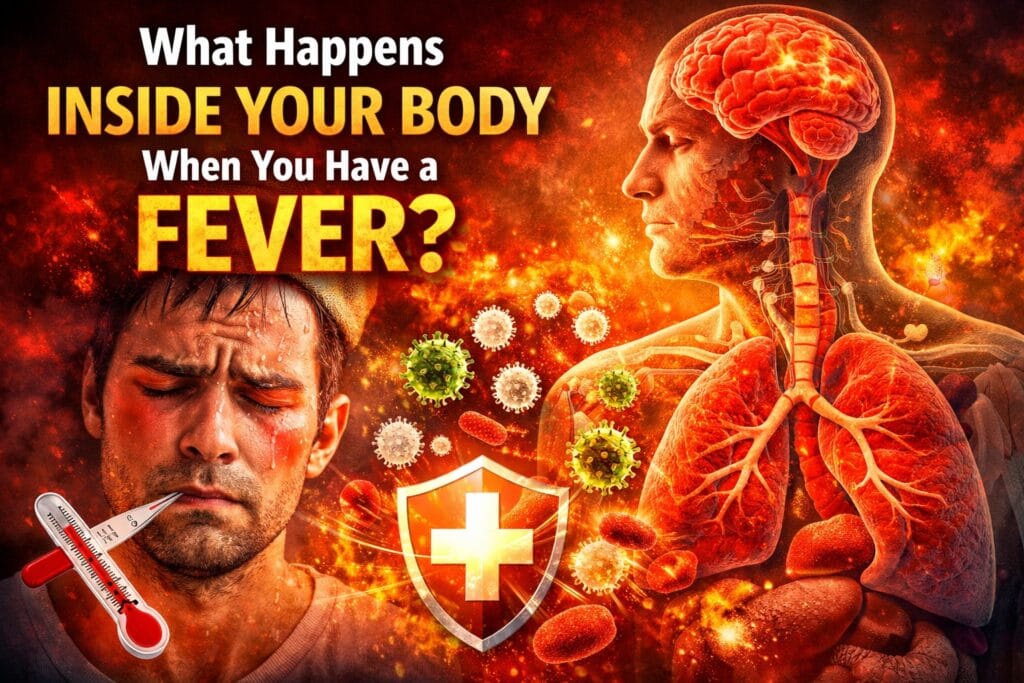

🌡 Fever Feels Bad… But It’s Actually Your Body Fighting Back
When your body temperature rises above normal (around 98.6°F or 37°C), you feel:why fever happens
- Weak
- Chilly
- Sweaty
- Headache
- Body pain
It feels like something is wrong.
But here’s the surprising truth:
👉 Fever is not the enemy.
👉 Fever is your immune system going into battle.
Let’s understand what really happens inside your body.
🦠 Step 1: The Body Detects an Invader
Most fevers are caused by:
- Viruses
- Bacteria
- Infections
- Inflammation
When harmful microbes enter your body, your immune system recognizes them as foreign.
Special immune cells release chemicals called pyrogens (fever-producing substances).
These pyrogens travel through your bloodstream to your brain.
🧠 Step 2: The Brain Raises the Temperature
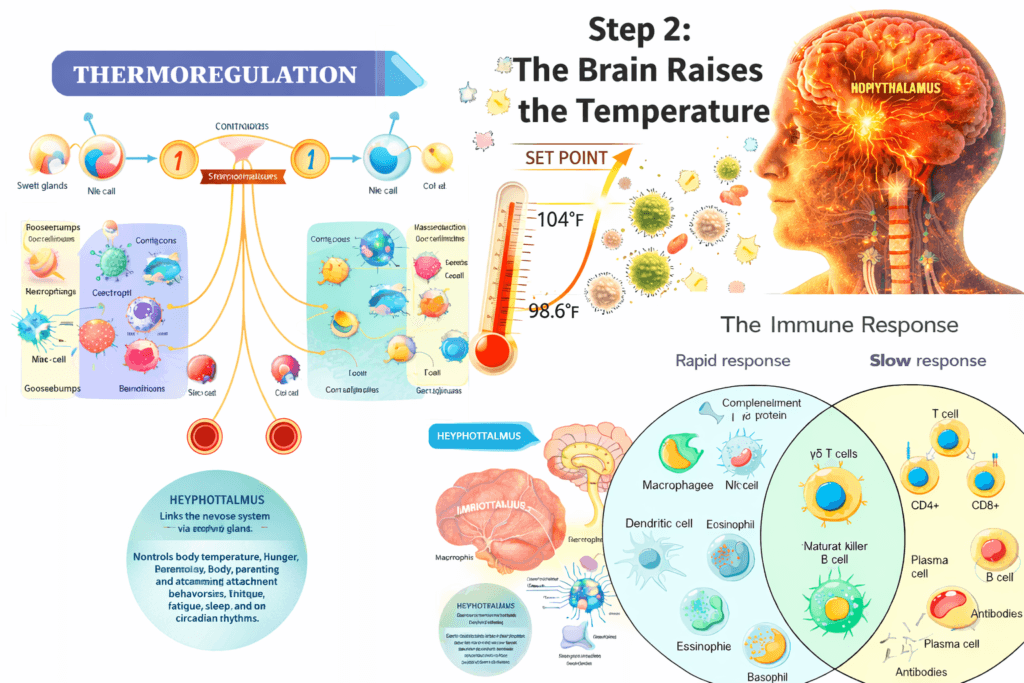
The pyrogens reach a small but powerful part of your brain called the Hypothalamus.
The hypothalamus acts like your body’s thermostat.
Normally, it keeps your temperature stable.
But when it receives signals from pyrogens, it increases the “set point.”
Your body now thinks:
👉 “We need to be hotter.”
❄ Why You Feel Cold During Fever
This is why you shiver.
Even though your temperature is rising, your body feels cold because:
- Blood vessels constrict
- Muscles start shivering
- You may get chills
Shivering generates heat.
Your body is actively trying to raise its temperature to match the new set point.
🔥 Step 3: Higher Temperature Slows Down Germs
Now comes the powerful part.
Most viruses and bacteria prefer normal body temperature.
When temperature rises:
- Microbes reproduce more slowly
- Some bacteria die
- Immune cells work more efficiently
Fever creates a hostile environment for pathogens.
It’s like turning up the heat to stop invaders from spreading.
🛡 Step 4: Immune System Becomes More Active
During fever:
- White blood cells multiply faster
- T-cells respond more aggressively
- Antibodies are produced more efficiently
Higher temperature enhances immune communication.
Your body is in full defense mode.
💦 Why You Sweat When Fever Breaks
Once the infection is controlled, pyrogen levels drop.
The hypothalamus resets your temperature to normal.
Now your body thinks:
👉 “We’re too hot.”
So it:
- Dilates blood vessels
- Starts sweating
- Releases heat
This is called the “fever breaking” stage.
🤔 Is Fever Always Bad?
Not necessarily.
Mild to moderate fever (100–102°F or 37.8–39°C):
✔ Helps fight infection
✔ Boosts immune response
✔ Slows bacterial growth
In many cases, fever is beneficial.
⚠ When Fever Becomes Dangerous
However, very high fever can be risky.
Above 104°F (40°C):
- Risk of dehydration
- Confusion
- Seizures (especially in children)
- Organ stress
That’s when medical attention is important.
Fever is helpful — but only up to a limit.
🧬 Why Body Temperature Is So Important
Your body maintains temperature through a process called thermoregulation.
Hypothalamus constantly balances:
- Heat production
- Heat loss
- Blood flow
- Sweating
- Shivering
Even a small change affects enzyme activity and cellular processes.
Your body is extremely sensitive to temperature shifts.
🧪 Interesting Fever Facts
✔ Fever is a symptom, not a disease.
✔ Exercise can temporarily raise body temperature (but that’s not infection fever).
✔ Babies and children get fevers more easily because their immune systems are still developing.
✔ Fever has been part of human survival for millions of years.
Evolution kept fever for a reason.
❤️ What Should You Do During Fever?
✔ Stay hydrated
✔ Rest
✔ Eat light food
✔ Monitor temperature
✔ Use medication only if needed
Not every fever requires immediate suppression.
Sometimes your body just needs support.
🧠 Why You Feel Weak During Fever
Fighting infection consumes energy.
Your body:
- Uses glucose rapidly
- Activates immune cells
- Produces inflammatory molecules
This energy shift causes fatigue.
Your body is prioritizing survival over productivity.
🌡 The Bigger Picture
Fever is one of the most powerful natural defense mechanisms humans have.
It may feel uncomfortable.
But it is a sign your immune system is working.
Instead of fearing mild fever, understand it.
Your body is not failing.
It is fighting.
🚀 Final Thought
Next time your temperature rises, remember:
When Your body has switched into defense mode.
Your brain has adjusted the thermostat.
Your immune army is activated.
And That’s not weakness.
That’s biological intelligence.
That’s real Science Gajab.
read also What is Inflammation?
❓ FAQ
Fever occurs when the immune system signals the brain to raise body temperature to fight infection.
Mild fever is often helpful, but very high fever can be dangerous.
Not always. Mild fever may help the body fight infection, but consult a doctor if symptoms are severe.
support us
If ScienceGajab helped you learn something new, please support us — even a small contribution makes a big difference.Your small contribution helps us create more free, quality science content for everyone.
Even ₹10 (0.11$) makes a difference.
You can support us instantly by scanning the UPI QR code below .

You can support us instantly by scanning the UPI QR code above.