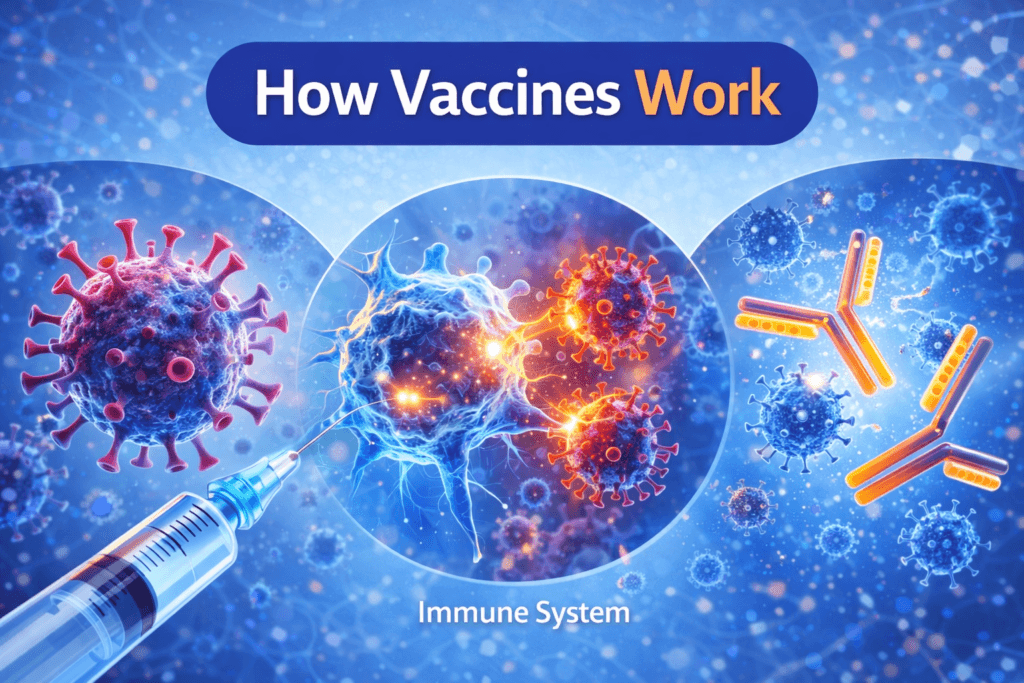

💉 How Vaccines Work (The Science Explained)
Vaccines are one of the most powerful medical tools ever developed. They train the immune system to recognize and fight dangerous germs before those germs can cause serious illness.how vaccines work
Instead of waiting for the body to battle a real infection, vaccines prepare the immune system in advance.
But how exactly does this process work?
Let’s explore the science behind vaccines.
🦠 Your Immune System: The Body’s Defense Army
Your immune system is designed to protect your body from harmful microorganisms such as:
- viruses
- bacteria
- parasites
When a pathogen enters the body, the immune system quickly begins a defense response.
This defense involves specialized cells called white blood cells, which search for and destroy invading germs.
However, the immune system performs best when it already recognizes the invader.
That’s where vaccines help.
🧬 What a Vaccine Contains
A vaccine does not usually contain a fully active virus or bacteria.
Instead, vaccines contain safe pieces of the pathogen, such as:
- weakened (attenuated) viruses
- inactivated viruses
- fragments of proteins from the pathogen
- genetic instructions that teach cells to produce harmless viral proteins
These components cannot cause the actual disease, but they look enough like the real pathogen to trigger an immune response.
🧠 Step 1: The Immune System Detects the Vaccine
After vaccination, immune cells recognize the foreign molecules in the vaccine.
These molecules are called antigens.
Antigens act like identification markers that tell the immune system something unfamiliar has entered the body.
Once detected, the immune system begins preparing its defense.
🛡 Step 2: The Body Produces Antibodies
The immune system produces special proteins called antibodies.
Antibodies attach to the antigens and help neutralize the invading pathogen.
Each antibody is designed to target a specific germ.
This means the immune system becomes highly specialized in fighting that particular infection.
🧠 Step 3: Immune Memory Is Created
One of the most important features of the immune system is immune memory.
After fighting the vaccine antigen, the body creates memory cells.
These cells remain in the body for months, years, or even decades.
If the real virus or bacteria enters the body later, these memory cells immediately recognize it.
The immune system then launches a rapid and powerful response.
⚡ Step 4: Faster Protection During Real Infection
Because the immune system has already been trained by the vaccine, it can respond much faster when exposed to the real pathogen.
Instead of taking several days to fight the infection, the immune system may destroy the pathogen before symptoms even appear.
This is why vaccinated individuals often avoid severe illness.
👥 Vaccines Also Protect Communities
Vaccination not only protects individuals but also protects communities.
When enough people are vaccinated, the spread of disease becomes much harder.
This is called herd immunity.
Herd immunity helps protect vulnerable people who cannot receive vaccines, such as:
- newborn babies
- people with weakened immune systems
- certain medical patients
🧪 Different Types of Vaccines
Scientists have developed several types of vaccines.
Live Attenuated Vaccines
Contain weakened versions of the virus.
Example: measles vaccine.
Inactivated Vaccines
Contain killed viruses that cannot reproduce.
Example: polio vaccine.
mRNA Vaccines
Use genetic instructions to teach cells to produce harmless viral proteins that trigger immunity.
Example: COVID-19 mRNA vaccines.
Subunit Vaccines
Contain only specific pieces of the pathogen.
Example: hepatitis B vaccine.
🌍 Why Vaccines Are Important
Vaccines have helped eliminate or control many dangerous diseases worldwide.
They have prevented millions of deaths from illnesses such as:
- smallpox
- polio
- measles
- tetanus
Vaccination remains one of the most effective ways to protect global health.
read Immune System: How Your Body Fights Diseases
🌟 The Bigger Picture
Vaccines work by training the immune system without causing the disease itself.
They allow the body to recognize dangerous pathogens and respond quickly if infection occurs.
Thanks to this remarkable scientific discovery, humans can prevent many diseases that once caused widespread suffering.
💡 Final Thought
Your immune system is powerful, but vaccines give it an important advantage: preparation.
By teaching the body how to recognize harmful germs in advance, vaccines transform the immune system into a faster and more effective defender.
And that preparation has saved countless lives around the world.
http://facebook.com/sciencegajab/