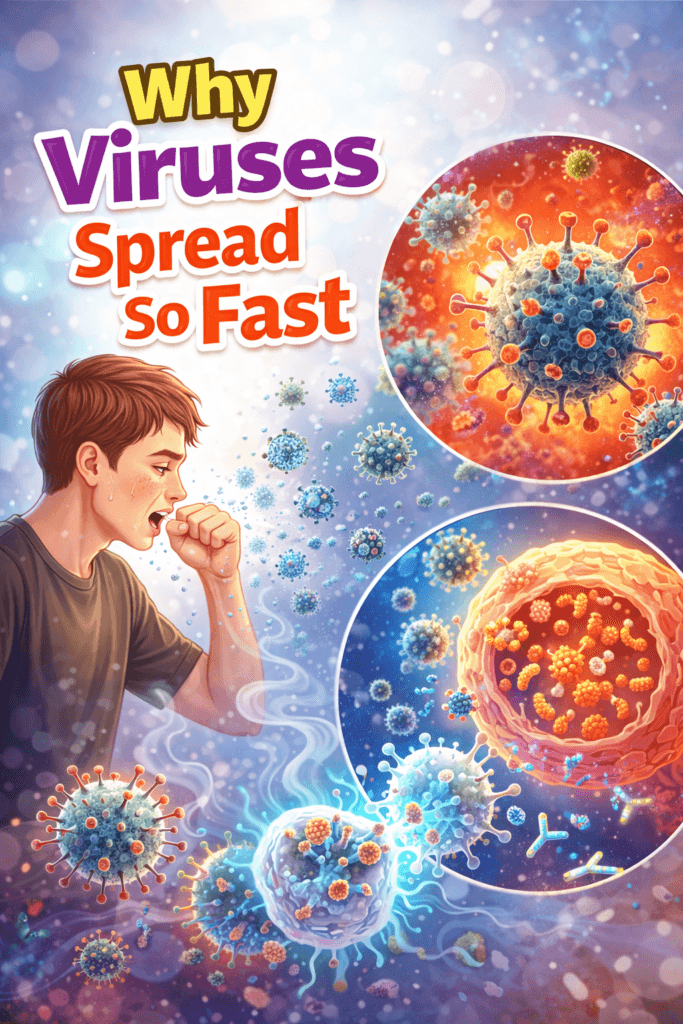

🦠 A Virus Can Spread Faster Than You Think
Have you ever noticed how one person catching a cold can lead to an entire office, school, or household getting sick within days?why viruses spread quickly
It often feels like viruses move faster than we expect. Someone sneezes, and suddenly several people begin showing symptoms.
This rapid spread is not random. It happens because viruses are designed by nature to spread efficiently between hosts.
From microscopic size to rapid reproduction, viruses have several advantages that allow them to move through populations quickly.
Let’s explore the fascinating science behind why viruses spread so easily.
🧬 What Exactly Is a Virus?
A virus is an extremely tiny infectious particle that is much smaller than bacteria.
Unlike bacteria, viruses are not fully living organisms. They cannot survive or reproduce on their own.
Instead, they must enter a living cell and hijack its machinery to create more copies of themselves.
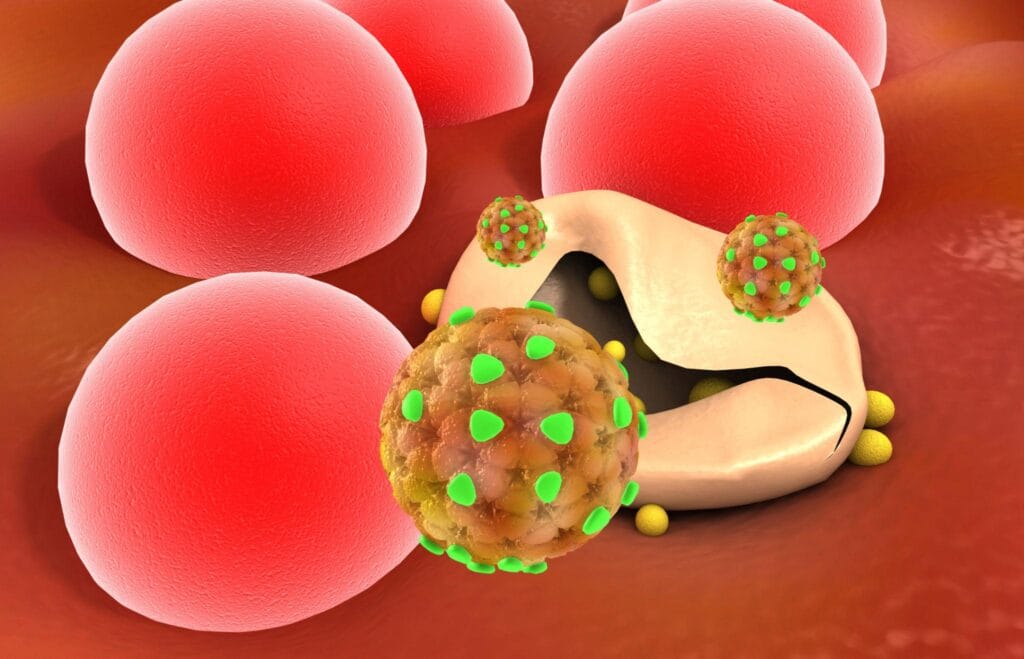
A virus typically contains:
- Genetic material (DNA or RNA)
- A protective protein shell
- Sometimes an outer envelope
Once inside a human cell, the virus forces that cell to produce thousands of new viruses.
learn 🦠 Difference Between Virus and Bacteria Explained
⚡ 1. Viruses Multiply Extremely Fast
One of the main reasons viruses spread quickly is their incredible replication speed.
After entering a cell, a virus begins to replicate its genetic material and create viral proteins.
Within hours, one infected cell can produce hundreds or even thousands of new virus particles.
These newly produced viruses burst out of the cell and infect nearby cells.
This chain reaction continues rapidly, allowing infections to spread quickly inside the body.
In some viral infections, millions of virus particles can be produced in a single day.
learn WHY NOT HEART TIRED
🌬️ 2. Viruses Travel Easily Through the Air
Many viruses spread through tiny respiratory droplets released when infected people:
- cough
- sneeze
- talk
- breathe
These droplets can carry virus particles through the air.
When another person inhales these droplets, the virus can enter their nose, mouth, or lungs.
Some viruses can even remain suspended in the air for short periods, increasing the chance of transmission.
Because humans interact closely every day, viruses can easily jump from person to person.
🤝 3. Humans Are Constantly in Contact
Viruses spread quickly partly because human behavior helps them travel.
People frequently interact through:
- handshakes
- shared surfaces
- crowded spaces
- public transportation
When a person touches a contaminated surface and then touches their face, viruses can enter the body through the eyes, nose, or mouth.
Since humans touch their faces many times each hour without realizing it, viruses get many opportunities to infect new hosts.
🧪 4. Viruses Can Mutate and Adapt
Viruses are constantly changing through genetic mutations.
These mutations sometimes make viruses:
- spread more efficiently
- evade immune defenses
- infect new hosts
Some viral mutations allow the virus to attach to human cells more easily, increasing transmission rates.
This ability to adapt is why new virus variants occasionally emerge and spread rapidly.
learn BIOLOGICAL CLASSIFICATION EXAMPLES
⏳ 5. People Can Spread Viruses Before Symptoms Appear
Another reason viruses spread so quickly is that infected individuals may not feel sick immediately.
During this early stage, called the incubation period, the virus is already multiplying inside the body.
People may continue daily activities such as working, traveling, or socializing.
This unknowingly spreads the virus before symptoms appear.
Many viral diseases spread primarily during this early phase.
🛡️ How the Immune System Fights Viruses
Fortunately, the human body has a powerful defense system called the immune system.
When a virus enters the body, immune cells begin detecting and attacking infected cells.
The immune response includes:
- white blood cells destroying infected cells
- antibodies attaching to viruses
- immune memory cells remembering the virus
Once the immune system recognizes a virus, it can often eliminate the infection and protect the body from future exposure.
💉 Why Vaccines Help Stop Virus Spread
Vaccines help prepare the immune system before a virus causes infection.
They expose the body to a harmless piece of the virus or a weakened version of it.
This allows the immune system to learn how to recognize the virus and produce antibodies.
Later, if the real virus enters the body, the immune system can respond much faster, stopping the infection early.
Vaccination not only protects individuals but also slows down virus transmission across communities.
🌍 Why Understanding Virus Spread Matters
Viruses are responsible for many common illnesses such as:
- common cold
- influenza
- COVID-19
- viral fevers
Understanding how viruses spread helps us take simple precautions that reduce transmission.
These include:
- washing hands frequently
- covering coughs and sneezes
- staying home when sick
- improving ventilation
- getting recommended vaccines
Even small preventive actions can significantly reduce viral spread.
🧠 Fascinating Science Fact
Every day, your immune system encounters thousands of microbes, including viruses.
Most of the time, it quietly destroys them before they cause any symptoms.
This invisible defense system works continuously to keep the body healthy.
❓ FAQ
Viruses replicate rapidly inside human cells and can easily travel through airborne droplets, allowing them to spread quickly between people.
Yes. Many viral infections spread during the incubation period before noticeable symptoms develop.
Some viruses can survive on surfaces for hours or even days depending on environmental conditions.
Crowded spaces increase close contact between people, making it easier for respiratory droplets containing viruses to move from one person to another.