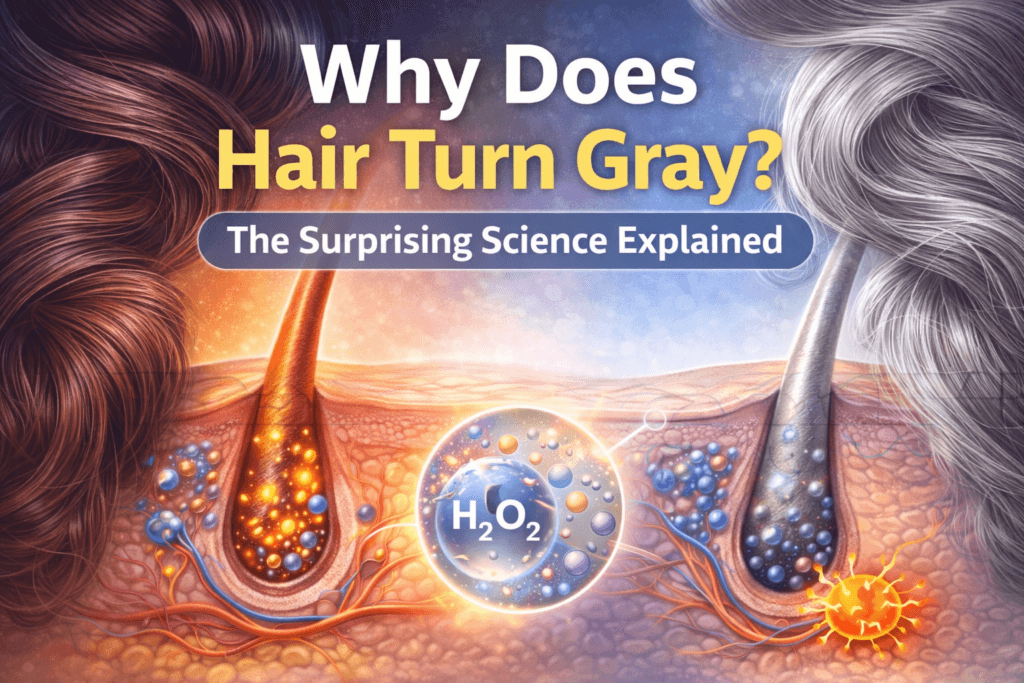

Hair turning gray is one of the most visible signs of aging. Many people notice their first gray hairs in their 30s or 40s, although some may see them much earlier. While gray hair is often associated with growing older, the process is actually controlled by biology, genetics, and changes inside hair follicles.
To understand why hair turns gray, we need to explore how hair gets its color and what happens when that coloring process begins to slow down or stop.
How Hair Gets Its Color
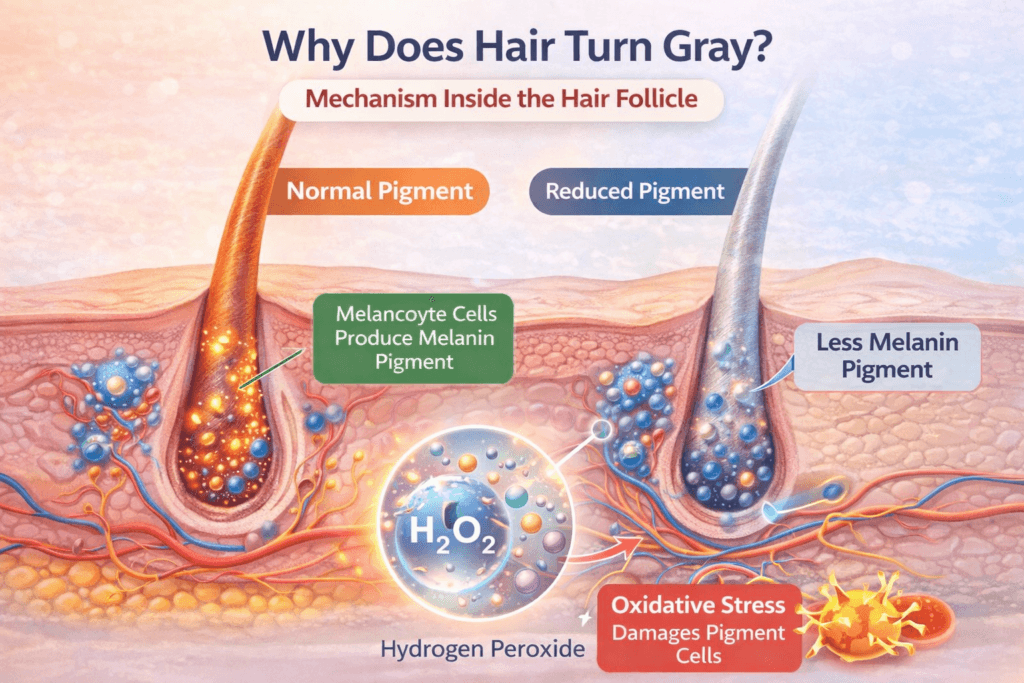
Hair color is determined by a natural pigment called melanin. This pigment is produced by specialized cells known as melanocytes, which are located in the hair follicles.
Hair follicles are tiny structures in the skin where hair grows. Within each follicle, melanocytes produce melanin and transfer it to keratin cells that form the hair strand.
There are two main types of melanin responsible for hair color:
- Eumelanin – produces black or brown hair
- Pheomelanin – produces red or yellow hair
The combination and concentration of these pigments determine whether your hair appears black, brown, blonde, or red.
When the body stops producing enough melanin, new hair grows with less pigment, making it appear gray, silver, or white.
The Role of Melanocyte Cells
Melanocytes are crucial for maintaining hair color. These cells continuously produce pigment as hair grows.
However, melanocytes do not last forever. Over time, these pigment-producing cells gradually become less active or die.
As the number of active melanocytes decreases, the amount of melanin produced also drops. When there is very little pigment left, the hair appears gray. When pigment production stops completely, hair becomes white.
This process typically occurs gradually, which is why people notice a mix of colored and gray hairs during the transition.
Aging and the Loss of Pigment
Aging is the most common reason hair turns gray.
As the body gets older, many biological processes slow down, including the activity of melanocytes. Scientists believe several factors contribute to this change, including:
- accumulation of cellular damage
- reduced ability of melanocytes to regenerate
- changes in hair follicle stem cells
- buildup of oxidative stress
Over time, these changes reduce the ability of hair follicles to produce pigment, leading to graying.
The Role of Oxidative Stress
One of the important scientific explanations for gray hair involves oxidative stress.
Oxidative stress occurs when harmful molecules called free radicals build up in cells. These molecules can damage proteins, DNA, and other cellular components.
Hair follicles naturally produce small amounts of hydrogen peroxide during metabolism. Normally, the body breaks down hydrogen peroxide using protective enzymes.
But with age, these protective systems become less effective. As hydrogen peroxide accumulates, it can interfere with melanin production, causing hair to lose its color.
This buildup of oxidative stress is believed to play a major role in the graying process.
Genetics Play a Major Role
One of the biggest factors determining when your hair turns gray is genetics.
If your parents or grandparents developed gray hair early, you are more likely to experience early graying as well.
Genes influence:
- the lifespan of melanocyte cells
- how quickly pigment production declines
- how hair follicles age
Because of genetics, some people may start getting gray hair in their 20s, while others maintain natural color well into their 50s or 60s.
Stress and Gray Hair
Many people believe that stress causes hair to turn gray overnight. While sudden graying is largely a myth, chronic stress may contribute to the process.
Scientific studies suggest that stress hormones can affect the stem cells responsible for producing melanocytes.
When these stem cells become depleted, the hair follicle may lose its ability to produce pigment permanently.
However, stress is usually not the main cause of gray hair—it may simply accelerate a process that is already influenced by aging and genetics.
Nutritional Factors
Certain nutrient deficiencies may also contribute to premature graying.
Important nutrients for hair pigmentation include:
- Vitamin B12
- Iron
- Copper
- Folate
These nutrients help support healthy hair follicles and pigment production. When levels are too low, melanocyte function may be affected.
However, most cases of gray hair are not caused by diet alone.
learn What Is Human Saliva Made Of? Composition and Functions Explained
Can Gray Hair Turn Back to Its Original Color?
In most cases, gray hair cannot naturally regain its original pigment once melanocytes stop producing melanin.
However, researchers are studying ways to potentially reverse or slow the process. Some experimental treatments focus on:
- protecting melanocyte stem cells
- reducing oxidative stress
- restoring melanin production
Although these treatments are still under investigation, they may provide insights into future approaches to hair pigmentation.
Why Some People Go Gray Earlier
Premature graying can occur for several reasons.
Possible causes include:
- genetic predisposition
- autoimmune conditions
- vitamin deficiencies
- thyroid disorders
- smoking
Smoking, in particular, has been linked to increased oxidative stress, which may damage melanocyte cells and accelerate hair graying.
learn What is Vitamin D deficiency?
The Difference Between Gray and White Hair
Many people use the terms gray and white hair interchangeably, but there is a slight difference.
- Gray hair occurs when hair still contains small amounts of pigment mixed with colorless strands.
- White hair occurs when pigment production stops completely.
The mixture of pigmented and non-pigmented hairs creates the gray appearance.
Is Gray Hair Healthy?
Gray hair itself is not harmful. It is simply a natural biological change that happens as the body ages.
However, gray hair may feel slightly different in texture because aging hair follicles often produce hair that is:
- thinner
- drier
- more fragile
Proper hair care can help maintain the health and appearance of gray hair.
learn Is It Safe to Eat Papaya While Pregnant?
The Bottom Line
Hair turns gray because the pigment-producing cells in hair follicles gradually stop producing melanin. This change occurs due to a combination of aging, genetics, oxidative stress, and biological changes in hair follicles.
While gray hair is often associated with aging, it is actually a complex biological process influenced by many factors. For most people, it is a natural and inevitable part of life.
Understanding the science behind gray hair helps explain why this change occurs and why it varies so much from person to person.
https://www.facebook.com/sciencegajab/