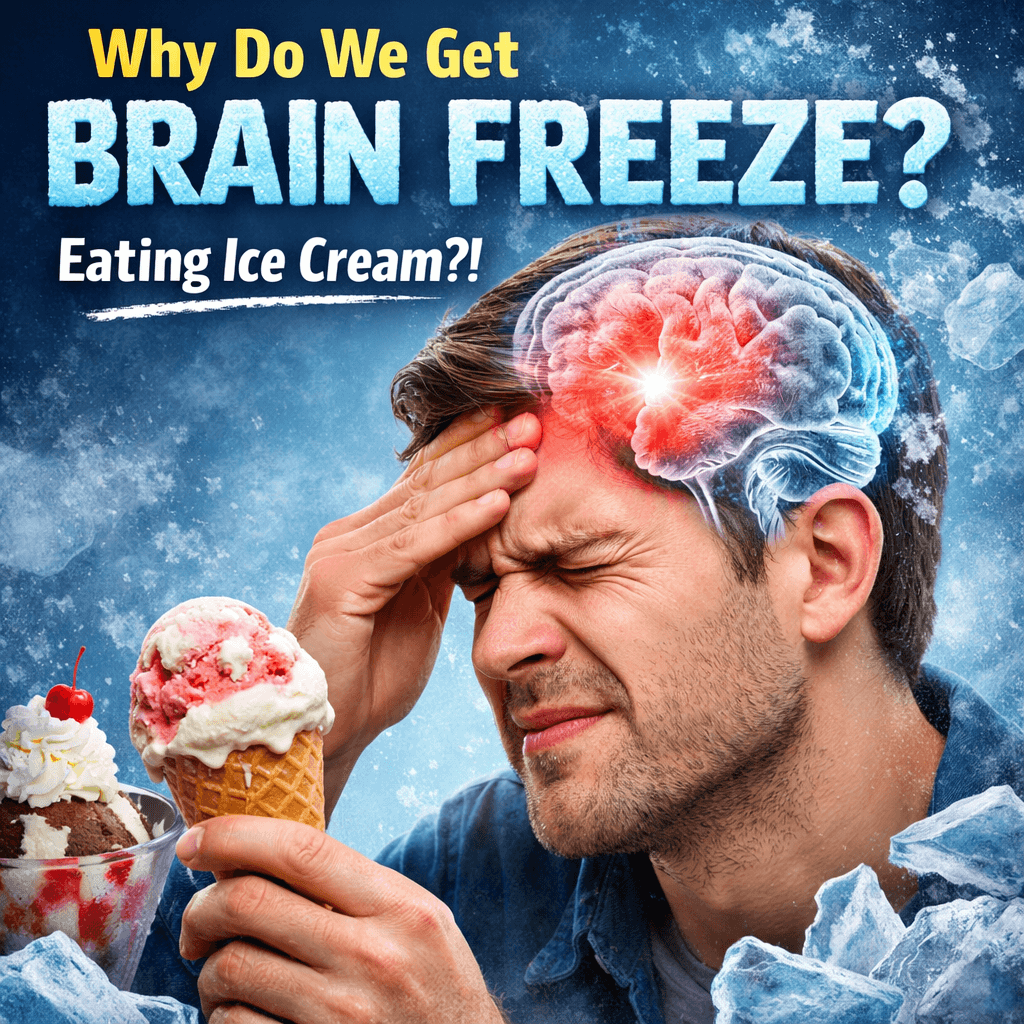

You take a big bite of ice cream… and suddenly a sharp pain hits your forehead.
It feels like your brain is freezing for a few seconds.
This strange sensation is called Sphenopalatine ganglioneuralgia, commonly known as brain freeze.
The good news? It’s temporary and harmless. But the science behind it is surprisingly fascinating.
learn Chemical coordination and integration ncert
What Exactly Is Brain Freeze?
Brain freeze is a rapid headache caused by cold food or drinks touching the roof of your mouth.
It usually lasts 5–30 seconds but can feel intense.
Common triggers include:
- Ice cream 🍦
- Frozen drinks 🥤
- Popsicles
- Slushies
Even very cold water can trigger it.
Discover 15.Human biology basics everyone should know
What Happens Inside Your Head?
Your mouth contains many sensitive nerves and blood vessels.
When something extremely cold touches the roof of your mouth, the body reacts quickly.
Here’s the step-by-step process:
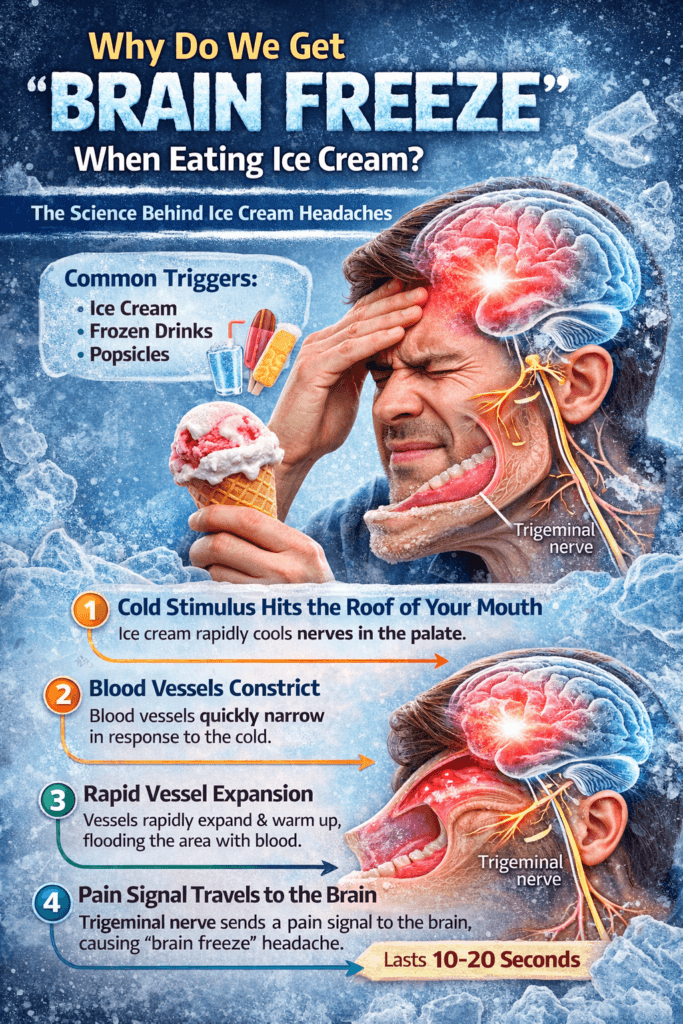
1. Cold Stimulus Hits the Roof of Your Mouth
The cold temperature rapidly cools nerves in the palate.
2. Blood Vessels Suddenly Constrict
The body tries to preserve heat by narrowing blood vessels.
3. Rapid Vessel Expansion
Moments later, blood vessels quickly expand again to restore normal temperature.
4. Pain Signal Travels to the Brain
The sudden change activates the Trigeminal nerve.
This nerve sends a pain signal to the brain — which we experience as brain freeze.
learn🧠 Blood Supply of the Brain: The Hidden Network That Keeps You Alive (Explained Simply!)
Why Does the Pain Feel Like It’s in Your Forehead?
Even though the cold is in your mouth, the pain is usually felt in the forehead.
This happens because the trigeminal nerve connects multiple areas of the face and head.
Your brain sometimes misinterprets the pain location, creating what scientists call referred pain.
learn Pain Isn’t Where You Think — The Brain’s Hidden Role Explained
Who Gets Brain Freeze More Often?
Brain freeze can happen to anyone, but it’s more common in:
- Children
- People who eat cold food quickly
- Individuals prone to Migraine
Studies show that people who experience migraines are more sensitive to cold triggers.
learn why we feel hungry
How to Stop Brain Freeze Instantly
Luckily, there are simple tricks to stop it quickly.
Press Your Tongue to the Roof of Your Mouth
This warms the cold area quickly.
Drink Something Warm
Warm water can help restore normal temperature.
Eat Cold Foods Slowly
Smaller bites reduce the temperature shock.
Most brain freezes disappear in less than 30 seconds.
Fascinating Fact About Brain Freeze
Researchers actually study brain freeze to understand migraine headaches.
Because both involve rapid blood vessel changes, studying this harmless headache may help scientists develop better migraine treatments.
learn Why Do Fingers Wrinkle in Water?
The Bottom Line
Brain freeze happens when extremely cold food rapidly changes blood vessel activity in the roof of your mouth.
Your nerves react quickly, sending pain signals through the trigeminal nerve — creating that sudden icy headache.
So next time you eat ice cream too fast, remember:
Your brain isn’t actually freezing…
It’s just your body reacting to extreme cold.
learn Hordeolum