Imagine losing a finger… and watching it grow back.
Sounds like science fiction, right?
But in nature, it’s completely normal.
Some animals can regrow entire limbs. So the big question is:
Can humans regrow body parts too?
The answer is surprising — and more complex than you think.
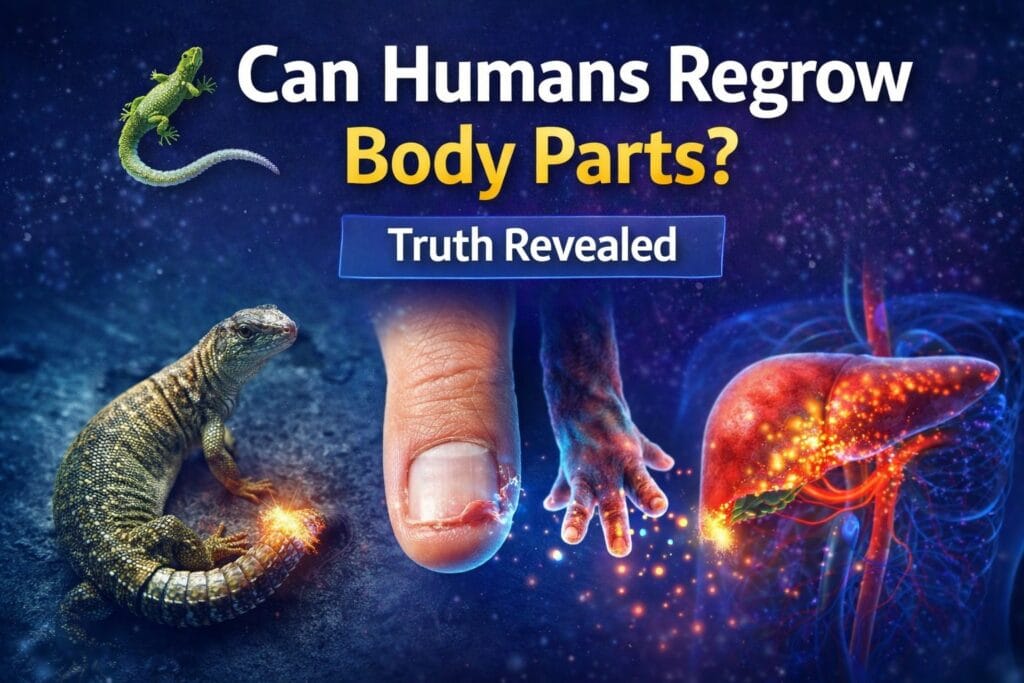
🧬 Animals That Can Regrow Limbs
In the animal kingdom, regeneration is real.
- 🦎 Lizards regrow their tails
- 🐟 Some fish regenerate fins
- 🦎 Salamanders can regrow full limbs
- ⭐ Starfish regrow arms
Scientists have studied salamanders for decades because they can regenerate bone, muscle, nerves, and even blood vessels perfectly.
Humans? Not quite the same.
🩹 What Humans Can Regrow
While we can’t regrow arms or legs, our bodies still have impressive repair abilities.
✔️ Skin
Your skin constantly regenerates. Minor cuts and wounds heal naturally.
✔️ Liver
The human liver can regrow up to 70% of its mass after surgical removal, as long as part of it remains.
Research from institutions like National Institutes of Health confirms the liver is one of the most regenerative organs in the human body.
✔️ Fingertips (Partially)
In some children — and rarely adults — the tip of a finger can regrow if the nail bed remains intact.
✔️ Blood Cells
Your body produces billions of new blood cells daily.
So yes — humans regenerate.
But not like salamanders.
🧪 Why Can’t Humans Regrow Limbs?
The difference lies in cellular programming.
When a salamander loses a limb:
- Cells near the wound “de-differentiate” (go back to stem-like state)
- They form a structure called a blastema
- The limb regrows perfectly
In humans:
- Wounds form scar tissue
- Cells focus on rapid closure
- Regeneration pathways shut down
Our bodies prioritize fast healing over perfect rebuilding.
🧠 The Role of Stem Cells
Stem cells are special cells that can turn into many different types of tissues.
Scientists in regenerative medicine are studying how stem cells might help humans regrow damaged tissues.
Organizations like Harvard Stem Cell Institute are researching ways to stimulate regenerative pathways in humans.
The future may hold breakthroughs — but we’re not there yet.
🦴 Can Science Make Limb Regrowth Possible?
Researchers are exploring:
- Stem cell therapy
- Tissue engineering
- 3D bioprinting
- Genetic activation of dormant pathways
Some lab experiments have successfully regrown small tissues in controlled conditions.
But full limb regeneration in humans is still theoretical.
⚡ Why Evolution Limited Human Regeneration
Here’s an interesting theory:
Humans evolved to prioritize:
- Rapid wound closure
- Infection prevention
- Survival in harsh environments
Scar tissue forms quickly — which reduces bleeding and infection risk.
In evolutionary terms, speed mattered more than perfection.
🚀 The Future of Regenerative Medicine
Scientists believe the future may include:
- Growing replacement organs
- Regenerating damaged nerves
- Healing spinal cord injuries
- Repairing heart tissue after heart attack
While regrowing an arm isn’t possible today, regenerative medicine is advancing faster than ever.
🧠 The Big Truth
Can humans regrow body parts?
🔹 Fully regrow limbs? ❌ No
🔹 Regenerate certain tissues? ✅ Yes
🔹 Future potential? 🚀 Very promising
Your body already has powerful healing abilities — just not the dramatic kind seen in salamanders.
But science is getting closer to unlocking that hidden potential.
🙏 Support ScienceGajab
ScienceGajab is dedicated to providing free, research-based science and health knowledge for everyone.
If our articles have helped you learn something new or understand your body better, please consider supporting us.
Even a small contribution helps us:
✔️ Create high-quality science content
✔️ Maintain website costs
✔️ Fight misinformation
✔️ Keep knowledge free for all
You can support us instantly by scanning the UPI QR code above.

💙 Every contribution matters.
Thank you for being part of the ScienceGajab family.