
💊 Antibiotics Don’t “Kill Germs” — They Target Specific Weak Points
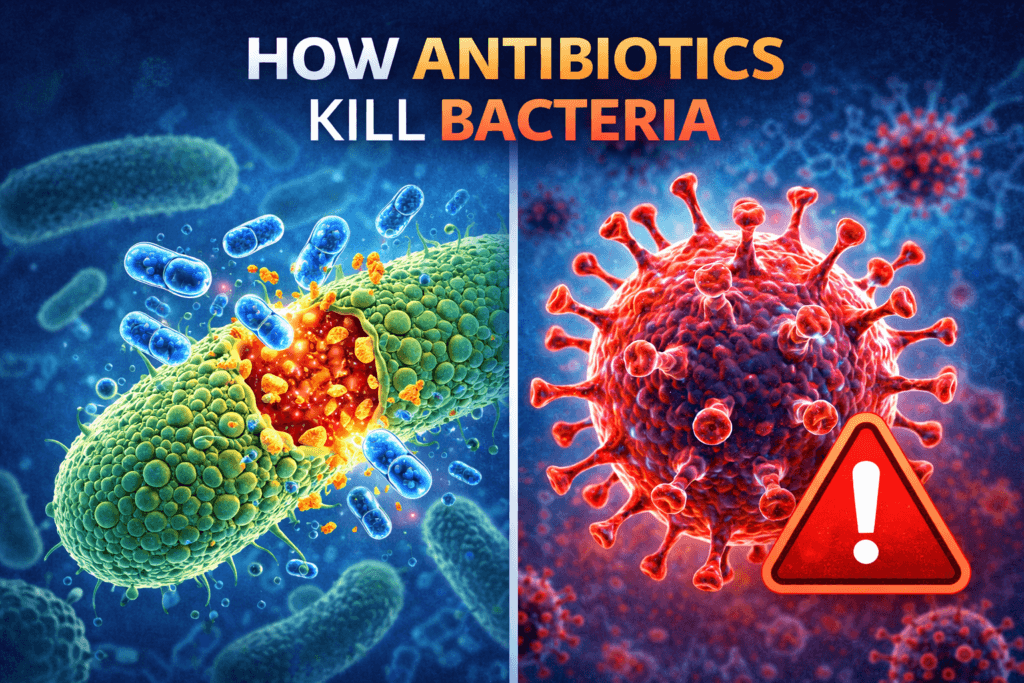
Many people think antibiotics kill all germs.how antibiotics kill bacteria
That’s not true.
Antibiotics are designed to attack bacteria only — and they do it by targeting structures that human cells do not have.
That precision is what makes them powerful — and why misuse is dangerous.
Let’s break down exactly how antibiotics work inside the body.
🦠 First: What Makes Bacteria Different From Human Cells?
Bacteria are single-celled organisms with unique features:
- A rigid cell wall
- Different ribosomes (protein-making machinery)
- Circular DNA
- Rapid reproduction rate
Human cells do not have a cell wall.
This difference is critical.
It allows antibiotics to target bacteria without harming most human cells.
🧱 1️⃣ Some Antibiotics Destroy the Bacterial Cell Wall
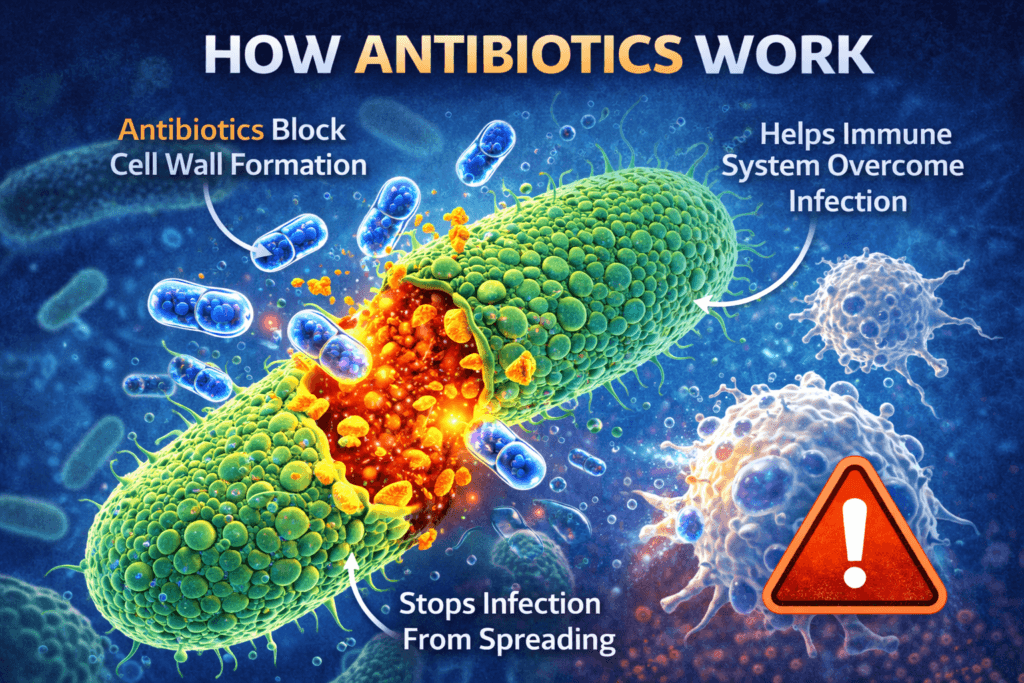
Certain antibiotics, like penicillin-type drugs, attack the bacterial cell wall.
The cell wall acts like protective armor.
When antibiotics block cell wall construction:
- The wall weakens
- Pressure builds inside the bacteria
- The cell bursts (lysis)
The bacteria literally breaks apart.
Without a wall, it cannot survive.
This is one of the most common and effective mechanisms.
🧬 2️⃣ Some Antibiotics Block Protein Production
Bacteria must constantly make proteins to survive and reproduce.
They do this using ribosomes.
Some antibiotics attach to bacterial ribosomes and:
- Stop protein assembly
- Prevent enzyme production
- Halt growth
Without proteins, bacteria cannot function.
They either die or stop multiplying.
🧪 3️⃣ Some Antibiotics Damage Bacterial DNA
Other antibiotics interfere with bacterial DNA replication.
Bacteria multiply quickly.
To divide, they must copy their DNA.
Certain drugs:
- Block DNA copying enzymes
- Prevent cell division
- Cause fatal genetic damage
Without DNA replication, bacteria cannot spread.
⚡ 4️⃣ Some Antibiotics Disrupt Metabolism
Bacteria need nutrients to survive.
Some antibiotics block key metabolic pathways.
This starves bacteria of essential molecules.
It’s like cutting off their fuel supply.
🧠 Why Antibiotics Don’t Work on Viruses
Viruses are completely different from bacteria.
Viruses:
- Have no cell wall
- Have no ribosomes
- Cannot reproduce alone
- Use human cells to replicate
Because viruses use your own cells’ machinery, antibiotics have nothing to target.
That’s why antibiotics do NOT treat:
- Common cold
- Flu
- COVID-19
- Most sore throats (unless bacterial)
Taking antibiotics for viral infections does not help.
And it can cause harm.
⚠ What Is Antibiotic Resistance?
Here’s where it gets serious.
When antibiotics are overused or misused:
- Some bacteria survive
- They adapt
- They develop resistance
Resistant bacteria become harder to treat.
Over time, drugs that once worked become ineffective.
This is called antibiotic resistance.
It is one of the biggest global health threats today.
🧬 How Bacteria Become Resistant
Bacteria are incredibly adaptable.
They can:
- Mutate quickly
- Share resistance genes
- Pump drugs out of their cells
- Change drug target sites
Some bacteria can even produce enzymes that destroy antibiotics.
That’s why doctors emphasize:
👉 Finish your prescribed course.
👉 Don’t self-medicate.
👉 Don’t use antibiotics unnecessarily.
🩺 What Happens After You Take an Antibiotic?
When you swallow an antibiotic:
- It enters your bloodstream.
- It travels to the infection site.
- It targets bacteria specifically.
- The immune system clears the weakened bacteria.
Antibiotics support your immune system.
They don’t replace it.
Your immune system still does much of the cleanup.
🌱 Do Antibiotics Affect Good Bacteria?
Yes.
Your body contains beneficial bacteria, especially in your gut.
Broad-spectrum antibiotics may:
- Kill helpful bacteria
- Disrupt digestion
- Cause diarrhea
- Lead to yeast infections
That’s why antibiotics should only be used when necessary.
🧠 Bactericidal vs Bacteriostatic
Not all antibiotics kill bacteria directly.
Two main types exist:
Bactericidal
- Kill bacteria directly
Bacteriostatic
- Stop bacteria from multiplying
- Allow immune system to eliminate them
Both approaches can treat infection effectively.
🔬 Why Timing Matters
Starting antibiotics too late can allow infection to spread.
Stopping them too early may leave surviving bacteria behind.
Correct timing and dosage are crucial for success.
💡 The Bigger Perspective
Antibiotics are one of the greatest discoveries in medical history.
Before antibiotics:
- Minor infections were deadly
- Surgery was extremely risky
- Childbirth complications were common
Today, antibiotics save millions of lives each year.
But their power depends on responsible use.
🚀 Final Thought
Antibiotics don’t “kill germs” randomly.
They target specific bacterial weaknesses:
- Cell wall
- Protein synthesis
- DNA replication
- Metabolic pathways
That precision is what makes them effective.
Understanding how they work helps protect their future.
That’s real Science Gajab.
🔥
❓ FAQ
Antibiotics kill bacteria by targeting their cell walls, protein production, DNA replication, or metabolic processes.
Viruses lack the structures antibiotics target and use human cells to reproduce.
Antibiotic resistance occurs when bacteria adapt and survive antibiotic treatment, making infections harder to treat.
Yes, broad-spectrum antibiotics can disrupt beneficial gut bacteria.