
The Science of Happiness: How Dopamine Hacks Your Brain. Dopamine’s Role in Brain Function
🧬 What Is Dopamine?
Dopamine is a powerful neurotransmitter — a chemical messenger that helps nerve cells communicate.
But here’s the twist 👇
Dopamine is NOT simply the “happiness chemical.”
Instead, it is the motivation and reward chemical.
It pushes you to:
- Chase goals
- Repeat pleasurable activities
- Feel excited
- Stay motivated
Without dopamine, you wouldn’t feel driven to do anything.
⚡ How Dopamine Actually Works
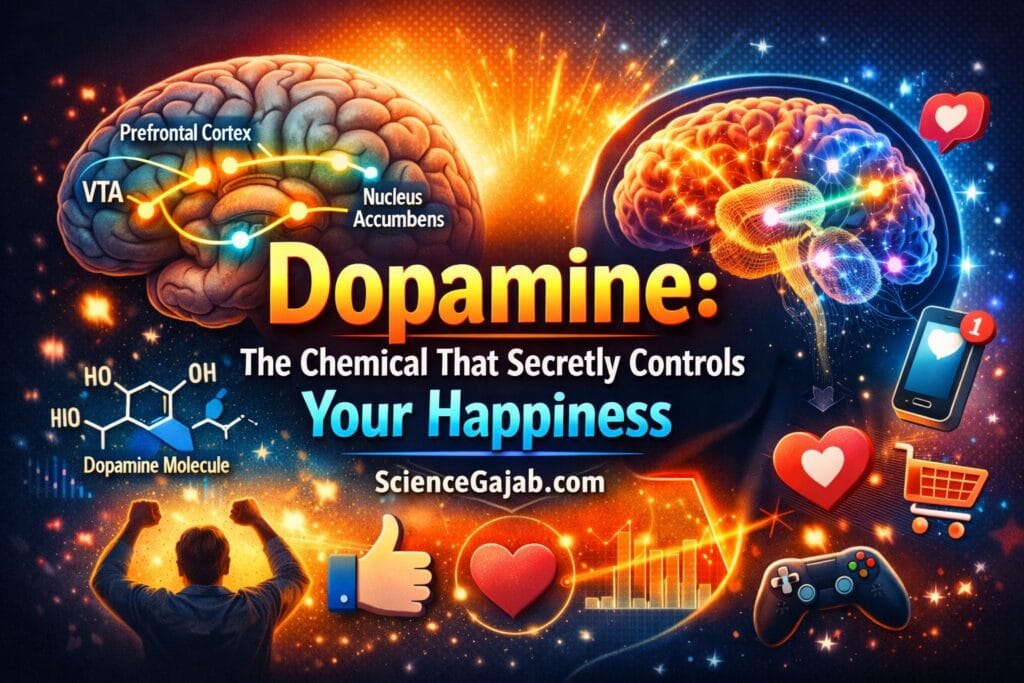
Dopamine travels through a special reward pathway in the brain called the mesolimbic pathway.
It mainly acts in areas like:
- Nucleus accumbens – pleasure & reward center
- Prefrontal cortex – decision-making
- Ventral tegmental area (VTA) – dopamine production hub
When something good happens (like eating tasty food or achieving a goal), dopamine levels rise.
Your brain then says:
“That felt good. Let’s do it again.”
That’s how habits are formed.
🎯 Dopamine Controls Motivation More Than Happiness
Many people think dopamine = happiness.
But science shows dopamine is more about anticipation than pleasure.
Example:
- Scrolling social media 📱
- Waiting for a message 💬
- Checking notifications 🔔
The excitement you feel? That’s dopamine.
It drives the “seeking” behavior.
Real pleasure involves other chemicals too — like serotonin and endorphins.
📲 Dopamine and Modern Life
Today’s world constantly stimulates dopamine:
- Social media likes
- Video games
- Junk food
- Online shopping
- Short videos
These activities give quick dopamine spikes.
But repeated spikes can lower sensitivity over time.
This is why:
- You get bored faster
- You need more stimulation
- Motivation drops
Your brain adapts.
🧪 What Happens When Dopamine Is Low?
Low dopamine levels are linked with:
- Lack of motivation
- Fatigue
- Brain fog
- Depression symptoms
- Difficulty focusing
In fact, conditions like Parkinson’s disease happen due to dopamine-producing cell loss.
🚨 Too Much Dopamine?
Excess dopamine activity is linked to:
- Addiction
- Risk-taking behavior
- Impulsivity
Substances like cocaine artificially boost dopamine, which is why addiction forms quickly.
🧠 The Dopamine Reward Cycle Explained
- You anticipate a reward
- Dopamine rises
- You act to get the reward
- Reward happens
- Brain remembers the behavior
Repeat = Habit formation.
That’s how everything from gym routines to scrolling addiction forms.
🌿 Natural Ways to Boost Dopamine (Safely)
Instead of chasing artificial spikes, try these science-backed methods:
✔ Exercise
Physical activity increases dopamine receptor sensitivity.
✔ Deep Sleep
Quality sleep resets dopamine pathways.
✔ Sunlight
Morning sunlight supports dopamine production.
✔ Protein-Rich Diet
Tyrosine (an amino acid) helps produce dopamine.
✔ Achieving Small Goals
Completing tasks gives healthy dopamine boosts.
🧩 Dopamine vs Serotonin: What’s the Difference?
| Dopamine | Serotonin |
|---|---|
| Motivation | Mood stability |
| Reward seeking | Emotional balance |
| Anticipation | Contentment |
| Drive | Calm happiness |
Both work together for mental well-being.
🤯 The Surprising Truth About Happiness
Happiness isn’t just about feeling good.
It’s about:
- Having goals
- Making progress
- Feeling purpose
- Experiencing reward
Dopamine fuels the pursuit.
Serotonin sustains the peace.
📈 Why This Matters in 2026
We live in a dopamine-driven world.
Notifications, reels, instant gratification — all designed to trigger your brain’s reward system.
Understanding dopamine helps you:
- Avoid addiction traps
- Improve productivity
- Stay motivated naturally
- Build healthier habits
Control dopamine…
And you control your life.
🎯 Final Words
Next time you reach for your phone or chase a goal…
Remember — it’s not just willpower.
It’s chemistry.
Your brain is wired for reward.
And now you know how it works. 🧠✨
read Why muscle fatigue & pain
No. Dopamine mainly controls motivation and reward anticipation, not pure happiness.
Low dopamine is linked to low motivation and certain depressive symptoms.
Exercise, sleep, sunlight, protein intake, and achieving goals help boost dopamine safely.
Yes, it creates short dopamine spikes that reinforce checking behavior.
If ScienceGajab helped you learn something new, please support us — even a small contribution makes a big difference.Your small contribution helps us create more free, quality science content for everyone.
Even ₹10 (0.11$) makes a difference.
You can support us instantly by scanning the UPI QR code below .