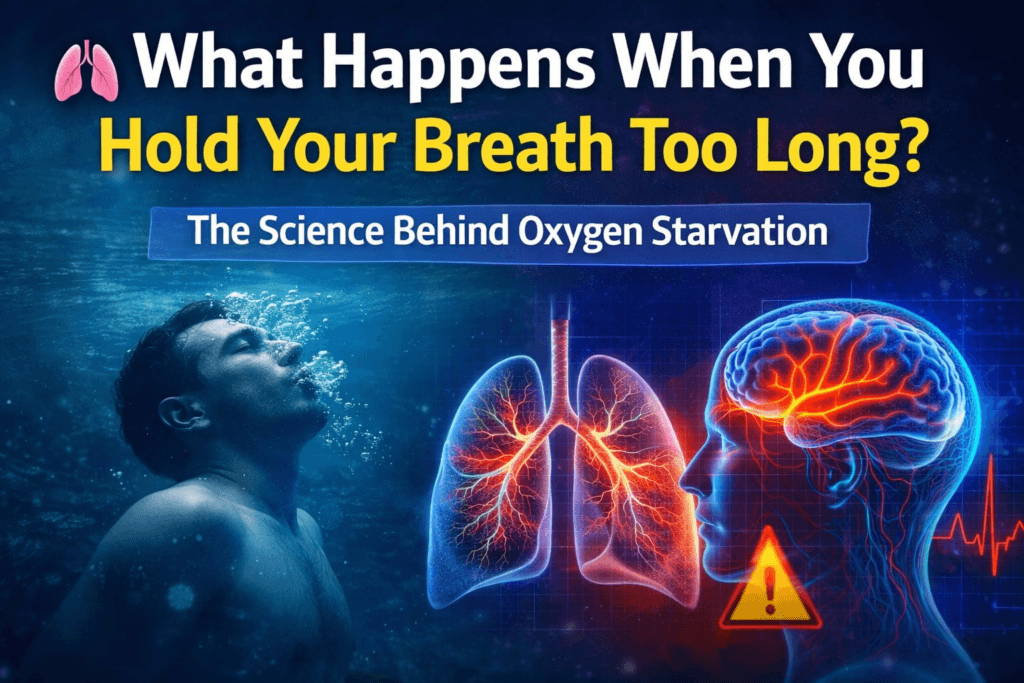

Try this for a moment. What happens when you hold your breath too long
Take a deep breath… and hold it.
Within seconds, your chest tightens. Your brain screams for air. Panic starts building.
But what’s really happening inside your body when you hold your breath too long?
The answer is more intense — and more dangerous — than you think.
Let’s break down the real science.
🧬 Oxygen: Your Body’s Lifeline
Every cell in your body depends on oxygen to produce energy.
When you inhale, oxygen travels to your lungs and enters tiny air sacs called alveoli. From there, it moves into your bloodstream and fuels your organs — especially your brain.
Your brain alone consumes about 20% of your body’s oxygen supply.
That’s why it’s the first organ to suffer when oxygen levels drop.
According to research supported by National Institutes of Health, brain cells begin to suffer injury within minutes without oxygen.
⏳ The Timeline: What Happens Second by Second
Let’s look at what happens if you hold your breath too long:
🟢 0–30 Seconds
- Oxygen levels begin to fall
- Carbon dioxide (CO₂) rises
- Slight discomfort appears
🟡 30–90 Seconds
- Strong urge to breathe
- Diaphragm spasms
- Heart rate may increase
🔴 2–3 Minutes
- Oxygen levels drop significantly
- Brain function begins to slow
- Risk of fainting increases
⚠️ 4–6 Minutes
- Brain cells begin to die
- Risk of permanent brain damage
🚨 6+ Minutes
- Severe brain injury likely
- Risk of death rises sharply
This condition is called hypoxia — when tissues don’t receive enough oxygen.
🧠 Why the Urge to Breathe Feels So Strong
Here’s a surprising fact:
The discomfort you feel isn’t caused by low oxygen.
It’s caused by rising carbon dioxide levels.
Your brainstem constantly monitors CO₂. When it builds up, it triggers an emergency signal to breathe.
This automatic control center ensures survival — even if you try to override it.
Studies in respiratory physiology from institutions like Harvard Medical School show that the respiratory drive is one of the strongest reflexes in the human body.
You cannot easily “decide” to stop breathing forever. Your body will force you to breathe — or you’ll lose consciousness first.
🌊 Why Free Divers Can Hold Breath for Minutes
Professional free divers train their bodies to tolerate higher CO₂ levels.
They:
- Slow their heart rate
- Increase lung capacity
- Train mental control
- Improve oxygen efficiency
Some elite divers can hold their breath for over 8–10 minutes under controlled conditions.
But here’s the danger:
They risk something called shallow water blackout — sudden unconsciousness due to oxygen dropping too low without warning.
That’s why breath-holding competitions are highly supervised.
🫀 What Happens to the Heart?
When oxygen drops:
- Heart rate initially rises
- Blood pressure may change
- Blood is redirected to vital organs
- Eventually heart rhythm may become unstable
If oxygen deprivation continues, cardiac arrest can occur.
Your body prioritizes survival — but only for so long.
🚨 Can You Die From Holding Your Breath?
In normal conditions, most people will faint before serious damage occurs.
When you faint:
- You fall
- Airway relaxes
- Breathing automatically resumes
However, underwater or in unsafe conditions, fainting can be fatal.
That’s why breath-holding games are extremely dangerous, especially in children.
🧪 The Brain’s Survival Mode
When oxygen falls critically low:
- The brain reduces non-essential functions
- Consciousness shuts down
- Energy is conserved
It’s a last-ditch survival attempt.
But brain cells are extremely sensitive. Unlike muscles, they cannot survive long without oxygen.
🧠 The Big Takeaway
Holding your breath triggers:
- Rising CO₂ levels
- Intense breathing reflex
- Brain oxygen stress
- Potential loss of consciousness
Your body is designed to breathe — continuously and automatically.
Breathing isn’t just a habit.
It’s a life-preserving reflex controlled by millions of years of evolution.
🙏 Support ScienceGajab
ScienceGajab is dedicated to providing free, research-based science and health knowledge for everyone.
If our articles have helped you learn something new or understand your body better, please consider supporting us.
Even a small contribution helps us:
✔️ Create high-quality science content
✔️ Maintain website costs
✔️ Fight misinformation
✔️ Keep knowledge free for all
You can support us instantly by scanning the UPI QR code above.

💙 Every contribution matters.
Thank you for being part of the ScienceGajab family.




Here is a well-written comment you can post under the blog article:
—
This article explains very clearly the dangers of holding your breath for too long. However, it’s important to mention that breath-holding in Yoga (called ‘Kumbhaka’ in Pranayama) is very different from risky breath-holding practices. In Yoga, breath retention is done in a controlled, gradual, and mindful way under proper guidance. The purpose is not to deprive the body of oxygen or push limits, but to improve lung capacity, concentration, and nervous system balance. Risky breath-holding, on the other hand, often involves forcing the body beyond its safe limits, especially underwater, which can lead to blackout or serious harm. So while extreme breath-holding can be dangerous, yogic breath retention — when practised correctly — is a safe and beneficial technique.
Thank you for this valuable clarification 🙏
You’re absolutely right — yogic Kumbhaka practiced in Pranayama is very different from unsafe or extreme breath-holding. As you mentioned, it is performed in a controlled, gradual, and mindful manner, typically under proper guidance, with the goal of improving lung function and nervous system balance — not pushing the body to dangerous limits.
Our article specifically discusses prolonged or forced breath-holding, especially in unsafe conditions like underwater, which can lead to hypoxia and blackout.
We truly appreciate you highlighting this important distinction. It adds meaningful depth to the discussion and helps readers better understand the difference between safe yogic practice and risky behavior.
Thank you for contributing to the conversation 💙
🤝🙏🌷