Glycolysis steps simple explanation
⚡ Introduction
Glycolysis is a word that sounds complex — but it’s actually a very basic process. It’s the first step of respiration, where your body or a plant takes glucose and begins breaking it down to make energy.
Let’s simplify this important process for you!
🍬 What is Glycolysis?
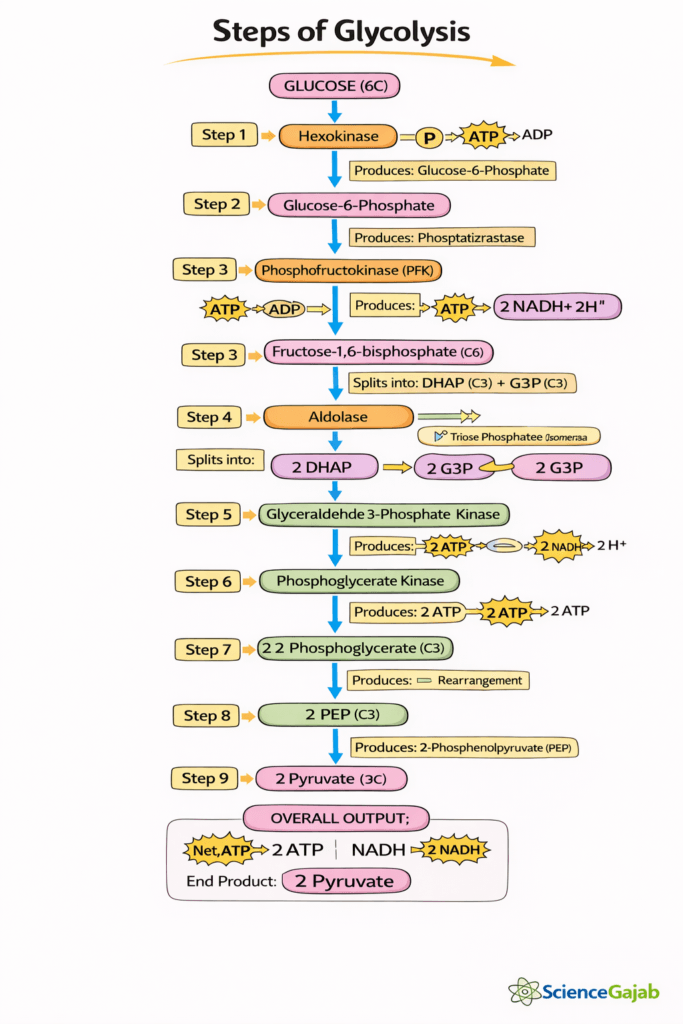
Glycolysis literally means “sugar splitting” (from Greek: glyco = sugar, lysis = breaking). It is the process where one glucose molecule (6 carbon atoms) is broken into two pyruvic acid molecules (3 carbon each).
🔬 It occurs in the cytoplasm of all living cells — plants, animals, bacteria, fungi — everyone does it!
🧪 Oxygen is NOT required for glycolysis. That’s why it’s called an anaerobic process.
🔟 10 Simple Steps of Glycolysis (Easy Breakdown)
Here’s how glucose gets broken down step by step:
| Step | What Happens | Enzyme Involved | ATP/NADH? |
|---|---|---|---|
| 1 | Glucose → Glucose-6-phosphate | Hexokinase | -1 ATP used |
| 2 | Glucose-6-phosphate → Fructose-6-phosphate | Phosphoglucose isomerase | – |
| 3 | Fructose-6-phosphate → Fructose-1,6-bisphosphate | Phosphofructokinase | -1 ATP used |
| 4 | Fructose-1,6-bisphosphate → 2 three-carbon sugars | Aldolase | – |
| 5 | One 3C sugar rearranged → PGAL (x2) | Triose phosphate isomerase | – |
| 6 | PGAL → 1,3-BPG | G3P dehydrogenase | +2 NADH made |
| 7 | 1,3-BPG → 3-PGA | Phosphoglycerate kinase | +2 ATP made |
| 8 | 3-PGA → 2-PGA | Mutase | – |
| 9 | 2-PGA → PEP | Enolase | – |
| 10 | PEP → Pyruvate | Pyruvate kinase | +2 ATP made |
✅ Final Products (from 1 glucose):
- 2 Pyruvate
- 2 ATP (net gain)
- 2 NADH
🔄 ATP Summary of Glycolysis
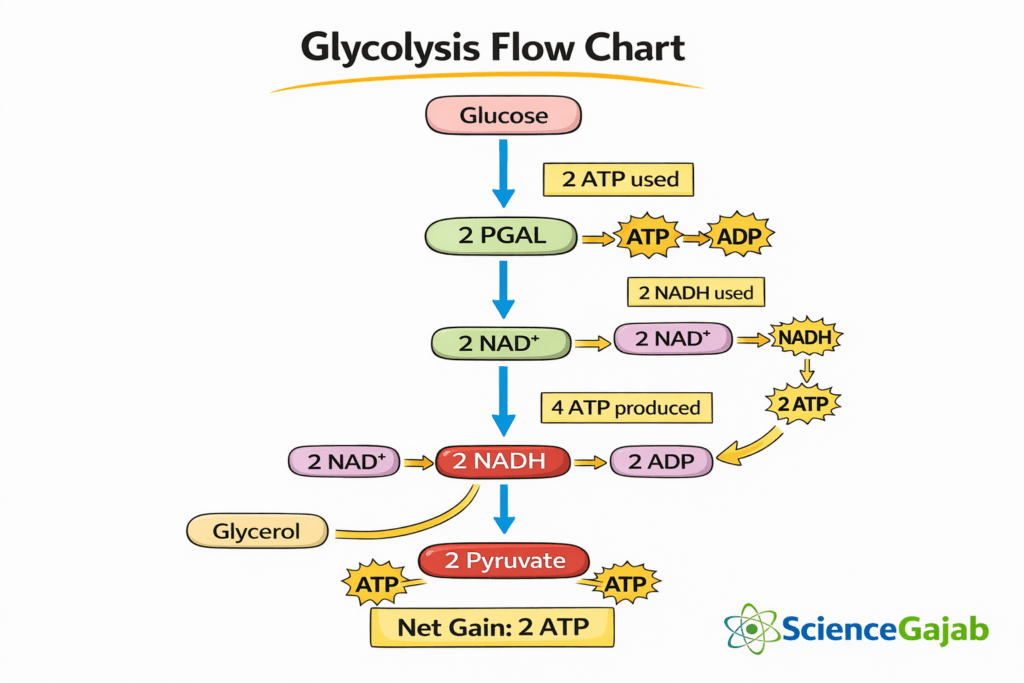
- ATP used: 2 (step 1 and 3)
- ATP made: 4 (step 7 and 10)
- ✅ Net gain = 2 ATP
- Plus, 2 NADH are made (used later in aerobic respiration to make more ATP)
🧪 Where Does Glucose Come From in Plants?
Plants make glucose from photosynthesis. But in glycolysis:
- Stored sugars like sucrose are broken down
- Enzyme invertase breaks sucrose into glucose + fructose
- These then enter the glycolysis cycle
⚗️ What Happens to Pyruvic Acid After Glycolysis?
That depends on oxygen availability:
- With oxygen (aerobic):
- Pyruvate goes into mitochondria → Krebs cycle → lots of ATP
- Without oxygen (anaerobic):
- Pyruvate → lactic acid (in animals)
- Or → ethanol + CO₂ (in yeast)
🔍 Why is Glycolysis Important?
- First step in energy release for all living organisms
- Produces ATP fast, even without oxygen
- Occurs in every cell type
- Connects to fermentation, Krebs cycle, and more
🎯 Quick Revision Points
- Glycolysis happens in cytoplasm
- Does not need oxygen
- Converts 1 glucose → 2 pyruvate
- Net 2 ATP + 2 NADH produced
- Leads into fermentation or aerobic respiration
💡 FAQs on Glycolysis
Q: Is glycolysis aerobic or anaerobic?
A: It’s anaerobic — it happens even without oxygen.
Q: What is the main product of glycolysis?
A: Pyruvic acid (pyruvate) — 2 molecules per glucose.
Q: How many ATP are made?
A: 4 total made, but 2 are used → net 2 ATP gained.
📚 Next Topic:
Let me know if you want:
- Proceed to Post 3: Fermentation vs Aerobic Respiration?