
reflex-action-explained-simply
Reflex Action Explained Simply (Easy Human Guide)
Have you ever touched a hot pan and pulled your hand away instantly?
Or blinked automatically when dust entered your eye?
These actions happen so fast that your body reacts before your brain even fully understands the danger. This amazing automatic response is called a reflex action.
Reflex actions are one of the smartest safety systems in the human body. They protect us from injury, help maintain balance, and keep important body functions running smoothly.
In this article, we’ll explain reflex action in the simplest possible way with:
- Easy definitions
- Daily life examples
- Reflex arc explanation
- Types of reflexes
- Importance in humans
- Medical relevance
- Difference between reflex and voluntary action
Whether you are a school student, NEET aspirant, MBBS learner, or just curious about the human body, this guide will make the topic crystal clear.
Parts of the Human Brain and Their Functions Explained | Science Gajab
What Is Reflex Action?
A reflex action is a quick, automatic, and involuntary response to a stimulus.
This means:
- It happens automatically
- You do not consciously control it
- It occurs very fast
- It protects the body
Neural Control and Coordination Explained (With Easy Diagrams + Examples)
Simple Definition
Reflex action is the body’s instant response to danger or stimulation without conscious thinking.
For example:
- Pulling your hand away from fire
- Sneezing when dust enters the nose
- Blinking when something comes near the eye
Why Reflex Actions Are Important
Imagine if your body waited for the brain to think carefully before reacting.
By the time the brain analyzed the danger:
- Your hand could already burn
- Your eye could get injured
- You could fall or get hurt
Reflex actions save time and protect the body immediately.
Main Functions of Reflex Actions
1. Protection From Injury
The body reacts instantly to harmful situations.
2. Maintaining Balance
Reflexes help us stand, walk, and maintain posture.
3. Protecting Internal Organs
Sneezing, coughing, and blinking defend sensitive organs.
4. Faster Response
Reflex pathways are shorter and quicker than conscious actions.
Can’t Focus? This Brain Hack Fixes It in Minutes
What Is a Stimulus?
A stimulus is any change that triggers a response.
Examples:
- Heat
- Pain
- Bright light
- Dust
- Loud sound
The body detects the stimulus and reacts automatically.
🏃♂️ How Your Body Moves: The Science of Locomotion & Movement in 5 Minutes– A Complete Guide
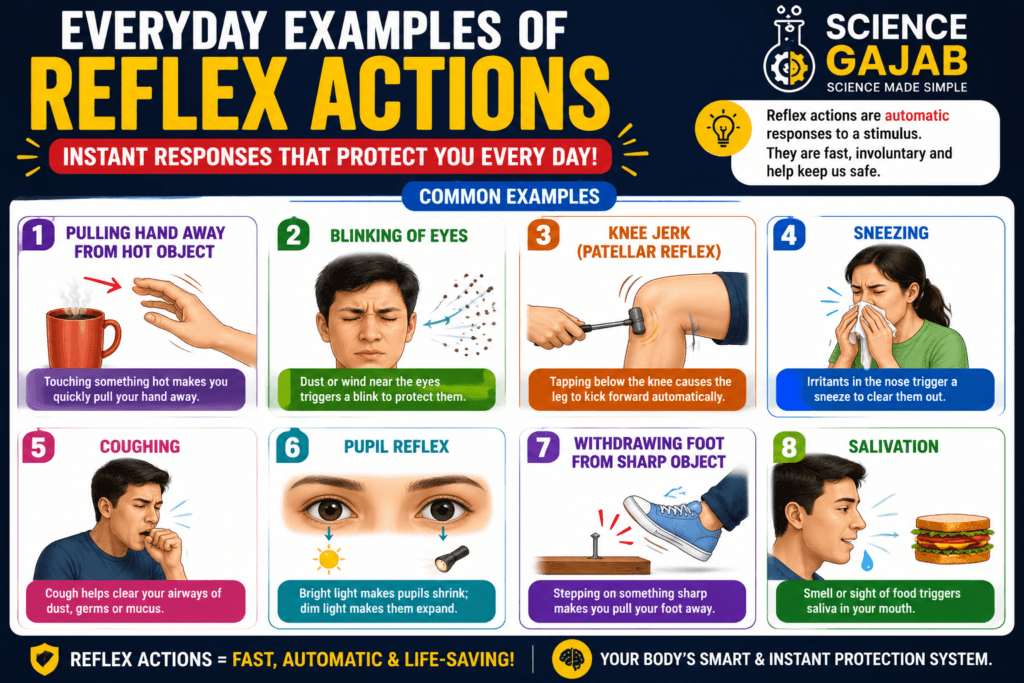
Everyday Examples of Reflex Actions
1. Pulling Hand From a Hot Object
The classic example of reflex action.
Before you consciously feel pain, your hand moves away.
2. Blinking Eyes
When dust or bright light enters the eye, blinking protects the eye surface.
3. Sneezing
The nose removes irritants like dust or pollen.
Why do we sneeze suddenly? The Simple Science Explained
4. Knee-Jerk Reflex
Doctors tap below the knee with a hammer and the leg kicks forward.
5. Coughing
Helps clear unwanted particles from the airway.
6. Pupil Reflex
Pupils become smaller in bright light.
Why So Many People Need Glasses Today
Reflex Arc Explained Simply
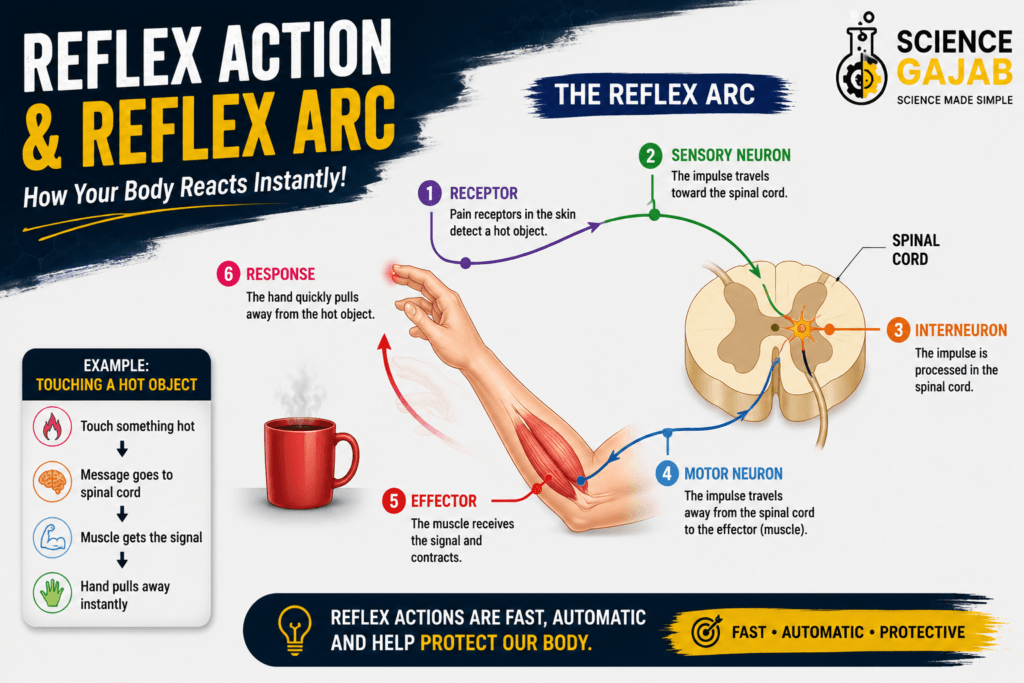
The path followed by nerve signals during a reflex action is called a reflex arc.
It is the shortest route for rapid action.
Components of Reflex Arc
There are mainly 5 parts:
1. Receptor
Detects the stimulus.
Example:
Skin receptors detect heat.
2. Sensory Neuron
Carries signals to the spinal cord.
3. Interneuron (Relay Neuron)
Located in the spinal cord.
Processes the signal quickly.
4. Motor Neuron
Carries commands from spinal cord to muscles.
5. Effector Organ
Muscle or gland that performs the action.
Example:
Arm muscles pull the hand away.
Parts of Ear and Their Functions (Simple Diagram Explained)
Reflex Arc Flow (Easy Sequence)
Stimulus → Receptor → Sensory Neuron → Spinal Cord → Motor Neuron → Muscle Response
Reflex Action and the Spinal Cord
Many reflex actions are controlled by the spinal cord, not the brain.
Why?
Because the spinal cord is closer and reacts faster.
The brain is informed afterward.
That’s why:
- You pull your hand first
- Feel pain a moment later
Does the Brain Play Any Role?
Yes.
Although the spinal cord handles the immediate response, the brain:
- Becomes aware of pain
- Learns from the event
- Helps remember dangerous situations
So reflexes are fast because they reduce unnecessary delay.
Can Brain Cells Really Regrow? The Surprising Science
Types of Reflex Actions
Reflexes can be divided into different types.
1. Natural (Inborn) Reflexes
These are present from birth.
Examples:
- Blinking
- Sneezing
- Swallowing
- Knee jerk
These do not need learning.
2. Conditioned Reflexes
These are learned through experience.
Example:
A student may feel nervous hearing the exam bell.
The famous scientist Ivan Pavlov demonstrated conditioned reflexes in dogs.
3. Somatic Reflexes
These involve skeletal muscles.
Example:
Hand withdrawal reflex.
The Science of Happiness: How Dopamine Hacks Your Brain
4. Autonomic Reflexes
These involve internal organs.
Examples:
- Pupil size changes
- Heart rate adjustments
- Salivation
Difference Between Reflex Action and Voluntary Action
| Feature | Reflex Action | Voluntary Action |
|---|---|---|
| Control | Automatic | Conscious |
| Speed | Very fast | Slower |
| Brain involvement | Minimal initially | Full involvement |
| Purpose | Protection | Intentional work |
| Example | Blinking | Writing |
Why Reflexes Are So Fast
Reflexes are fast because:
- Short nerve pathway
- Immediate spinal cord response
- No detailed thinking required
The body prioritizes survival.
Why Do We Yawn? The Real Reason Behind Yawning
The Science Behind Reflexes
Nerves carry electrical signals through neurons.
When a dangerous stimulus occurs:
- Receptors detect it
- Electrical impulses travel rapidly
- Spinal cord responds instantly
- Muscles contract
This entire process may happen in milliseconds.
Why Do Onions Make You Cry? The Shocking Science 99% People Don’t Know😳
What Happens When You Touch Something Hot?
Let’s understand step-by-step.
Step 1: Skin Detects Heat
Pain receptors in the skin sense danger.
Step 2: Sensory Neuron Sends Signal
Message travels to spinal cord.
Step 3: Spinal Cord Processes It
An immediate command is generated.
Step 4: Motor Neuron Activated
Signal travels to arm muscles.
Step 5: Hand Withdraws
Muscles contract rapidly.
Step 6: Brain Receives Information
You consciously feel pain afterward.
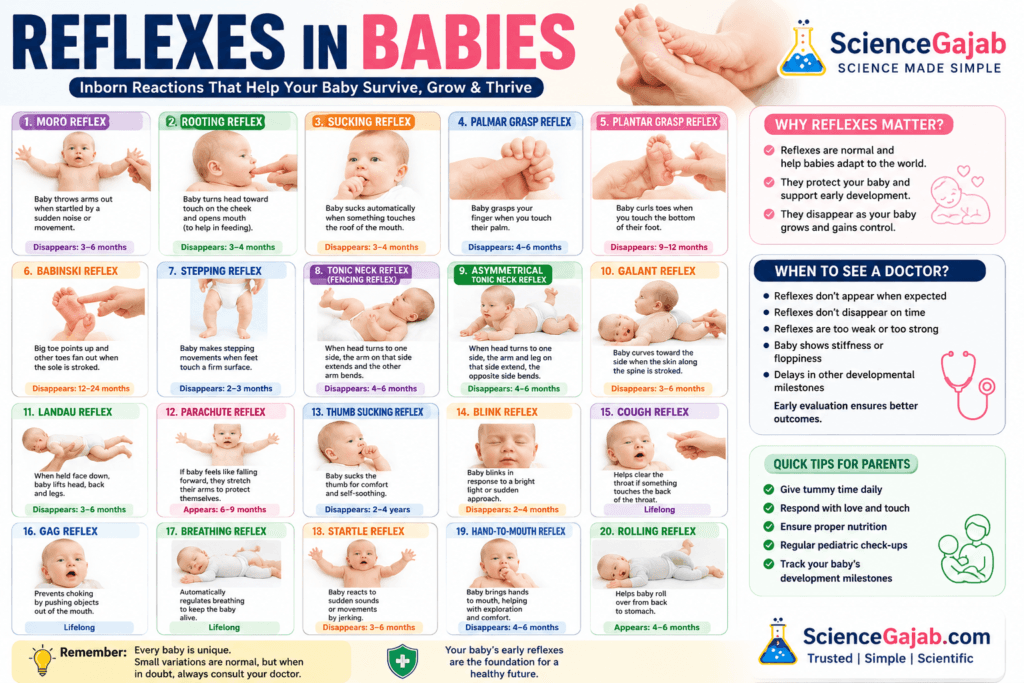
Reflexes in Babies
Babies are born with several reflexes.
These help doctors assess nervous system health.
Important Infant Reflexes
Rooting Reflex
Baby turns toward touch on the cheek.
Sucking Reflex
Helps feeding.
Grasp Reflex
Baby tightly holds a finger.
Moro Reflex
Startle response to sudden movement.
Causes of Sudden Blurry Vision (Simple Explanation You Can Trust)
Medical Importance of Reflexes
Doctors check reflexes during neurological examinations.
Abnormal reflexes may indicate:
- Nerve damage
- Brain disorders
- Spinal cord injury
- Vitamin deficiencies
- Neurological diseases
What Is the Knee-Jerk Reflex?
This is one of the most common reflex tests.
When the tendon below the knee is tapped:
- Sensory nerves are stimulated
- Spinal cord responds
- Leg kicks forward
Doctors use it to assess nervous system function.
Can Reflexes Become Weak?
Yes.
Weak reflexes may occur due to:
- Nerve injury
- Diabetes
- Vitamin B12 deficiency
- Spinal cord disorders
- Certain medications
Can Reflexes Become Excessive?
Overactive reflexes may occur in:
- Brain injury
- Stroke
- Upper motor neuron lesions
- Neurological diseases
Doctors call this hyperreflexia.
Modes of Virus Transmission with Examples (Airborne, Vector, Contact) – Easy Guide for Students
Reflexes and Sports
Athletes often train reflexes.
Fast reflexes improve:
- Reaction time
- Coordination
- Balance
- Performance
Examples:
- Cricket wicketkeepers
- Goalkeepers
- Boxers
- Racing drivers
Interesting Facts About Reflex Action
1. Reflexes Can Save Your Life
They help avoid dangerous injuries instantly.
2. Some Reflexes Happen Without Awareness
You may not even notice them.
3. Reflexes Continue During Sleep
Certain protective reflexes remain active.
4. Animals Also Have Reflexes
Even simple organisms show reflex-like responses.
Feeling Weak After Fever? Do This to Recover Faster (Doctor-Backed Guide)
Reflex Action in Animals
Animals rely heavily on reflexes for survival.
Examples:
- Deer running from danger
- Cats blinking rapidly
- Dogs withdrawing paws from pain
Fast responses improve survival chances.
Common Myths About Reflexes
Myth 1: Reflexes Are Controlled Fully by the Brain
False.
Most immediate reflexes are spinal cord mediated.
Myth 2: Reflexes Need Thinking
False.
They happen automatically.
Myth 3: Faster Reflexes Mean Higher Intelligence
Not necessarily.
Reflex Action and Evolution
Reflexes developed over millions of years to improve survival.
Quick reactions helped humans and animals:
- Escape predators
- Avoid injuries
- Protect vital organs
That’s why reflex systems are highly efficient.
Can Low Vitamins Damage Nerves? (Simple Explanation You Can Trust)
Disorders Affecting Reflexes
Some medical conditions alter reflexes.
1. Peripheral Neuropathy
Damaged nerves reduce reflexes.
2. Parkinson’s Disease
Movement and reflexes may become abnormal.
3. Stroke
Can produce exaggerated reflexes.
4. Spinal Cord Injury
May interrupt reflex pathways.
How Doctors Test Reflexes
Doctors use a reflex hammer.
Common reflex tests:
- Knee jerk
- Ankle reflex
- Biceps reflex
- Triceps reflex
These help identify nervous system problems.
Reflex Action vs Reaction Time
They are not exactly the same.
Reflex Action
Automatic and involuntary.
Reaction Time
Conscious response after thinking.
Example:
- Reflex: blinking suddenly
- Reaction: catching a ball intentionally
Simple Mnemonic to Remember Reflex Arc
“R-S-I-M-E”
- R = Receptor
- S = Sensory neuron
- I = Interneuron
- M = Motor neuron
- E = Effector
Easy for exams and quick revision.
🧠 What Happens During a Migraine? (Science Explained)
Reflex Action in Emergency Situations
Reflexes become extremely important during:
- Burns
- Falls
- Sudden pain
- Eye protection
- Breathing emergencies
Without reflexes, injuries would be much more severe.
Can Reflexes Be Improved?
Some reflexes can improve with:
- Practice
- Sports training
- Hand-eye coordination exercises
- Video games
- Martial arts
However, basic protective reflexes are naturally built into the body.
Reflex Action in Daily Life
You use reflexes every day without realizing it.
Examples:
- Pulling foot away from sharp objects
- Blinking while driving
- Sneezing
- Maintaining posture
- Balancing while walking
The nervous system constantly protects you silently.
Quick Summary
- Reflex action is a rapid automatic response.
- It protects the body from danger.
- Reflexes usually involve the spinal cord.
- Reflex arc is the pathway of nerve impulses.
- Reflexes are important in medicine and daily life.
- Examples include blinking, sneezing, and withdrawing from pain.
🫁 Importance of Oxygen in Respiration: Why Every Cell Needs It
Frequently Asked Questions (FAQs)
Reflex action is a quick automatic response of the body to a stimulus without conscious thinking.
Most reflex actions are controlled by the spinal cord.
It protects the body from injury and danger.
It is the pathway followed by nerve impulses during a reflex action.
Yes, blinking is a protective reflex.
The corneal blink reflex is among the fastest.
Final Thoughts
Reflex actions may seem simple, but they are one of the most powerful protective mechanisms in the human body.
Every second, your nervous system works silently to:
- Protect your eyes
- Prevent burns
- Maintain balance
- Keep you safe
Without reflexes, even small dangers could become serious injuries.
The next time you instantly pull your hand away from something hot or blink automatically, remember — your body reacted before your mind even had time to think.
That is the amazing science of reflex action.
About This Article
This article is written in simple educational language for students, biology learners, and general readers interested in understanding the human nervous system. Information is based on standard biology and medical science concepts commonly taught in school and medical education.
Educational Purpose
This content is for educational awareness only and should not replace professional medical advice or neurological evaluation.
Sources & References
- NCERT Biology Textbook
- Guyton and Hall Textbook of Medical Physiology
- Basic Human Anatomy & Physiology references