
✅ Blog Post 4: Krebs Cycle (TCA Cycle) Made Easy | With Steps & Diagram
🔬 Introduction
The Krebs Cycle, also known as the Citric Acid Cycle or TCA Cycle, is a crucial part of aerobic respiration. It happens in the mitochondria and produces energy-rich molecules like ATP, NADH, and FADH₂.
In this post, we’ll break it down into simple steps, so even beginners can understand.
📍 Where Does the Krebs Cycle Happen?
- Takes place in the mitochondrial matrix (inside mitochondria)
- Only happens when oxygen is available
- Comes after glycolysis, which forms pyruvic acid
🧪 How Does the Krebs Cycle Start?
- Pyruvate (from glycolysis) enters mitochondria.
- It is converted into Acetyl CoA (a 2-carbon molecule).
- Acetyl CoA combines with Oxaloacetic acid (4-carbon) to form Citric Acid (6-carbon).
This begins the cycle.
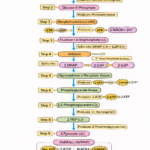
🔁 Krebs Cycle Steps in Simple Language
| Step | What Happens | Key Output |
|---|---|---|
| 1 | Acetyl CoA + OAA → Citric Acid | – |
| 2 | Citric Acid → Isocitrate | – |
| 3 | Isocitrate → α-Ketoglutarate | CO₂ released, NADH made |
| 4 | α-Ketoglutarate → Succinyl-CoA | CO₂ released, NADH made |
| 5 | Succinyl-CoA → Succinate | GTP (→ ATP) made |
| 6 | Succinate → Fumarate | FADH₂ made |
| 7 | Fumarate → Malate | – |
| 8 | Malate → Oxaloacetate (OAA) | NADH made |
🔄 Then, the cycle repeats with new Acetyl CoA.
⚡ What’s Produced in One Cycle?
For one molecule of Acetyl CoA, the cycle produces:
- 3 NADH
- 1 FADH₂
- 1 ATP (via GTP)
- 2 CO₂
🧮 For 1 glucose (which gives 2 Acetyl CoA):
- 6 NADH
- 2 FADH₂
- 2 ATP
- 4 CO₂
🌬️ Where Does the Energy Go?
The NADH and FADH₂ made in the cycle carry electrons to the Electron Transport System (ETS), where most ATP is produced.
➡️ Krebs cycle is like a fuel loader — it fills up energy carriers!
📚 Why is it Called a Cycle?
Because it ends with oxaloacetic acid (OAA), the same compound it starts with. This allows the process to restart again with a new Acetyl CoA.
🧠 Quick Recap
- Happens in mitochondrial matrix
- Needs oxygen
- Starts with Acetyl CoA
- Produces CO₂, NADH, FADH₂, ATP
- Connects to the ETS for more ATP
- Called TCA cycle because of citric acid (a tricarboxylic acid)
💡 Fun Facts
- Named after Hans Krebs, who discovered it in 1937
- It’s found in almost all aerobic organisms
- One of the most efficient energy-producing processes in biology
📌 FAQs on Krebs Cycle
Q: What is the main function of Krebs cycle?
A: To extract high-energy electrons (NADH, FADH₂) for ATP production.
Q: Why does it happen in mitochondria?
A: Because mitochondria have the required enzymes and structure.
Q: Is ATP directly made in Krebs cycle?
A: Yes, one GTP → ATP per cycle turn.
🔗 Want to Learn More?
- Respiration in Plants – Simple Guide (Post 1)
- Glycolysis Explained Step-by-Step (Post 2)
- Fermentation vs Respiration (Post 3)