
Author: ScienceGajab Editorial Team
Reviewed For Accuracy: Health & Science Content Review
Last Updated: Nov 2026
Why Do We Blush?
Have you ever felt your face suddenly become warm and red after receiving a compliment, making a mistake, or finding yourself in an embarrassing situation? This reaction, known as blushing, is one of the most curious and uniquely human behaviors.
Unlike many bodily responses that we can control, blushing happens automatically. No matter how hard we try to hide it, our face often reveals our emotions before we can stop it.
Scientists have long been fascinated by blushing because it appears to be uniquely human and closely tied to social emotions. But why does it happen, and what purpose does it serve?
Let’s explore the surprising science behind why we blush.
What Is Blushing?
Blushing is the sudden reddening of the skin, usually on the:
- Cheeks
- Nose
- Forehead
- Ears
- Neck
- Upper chest
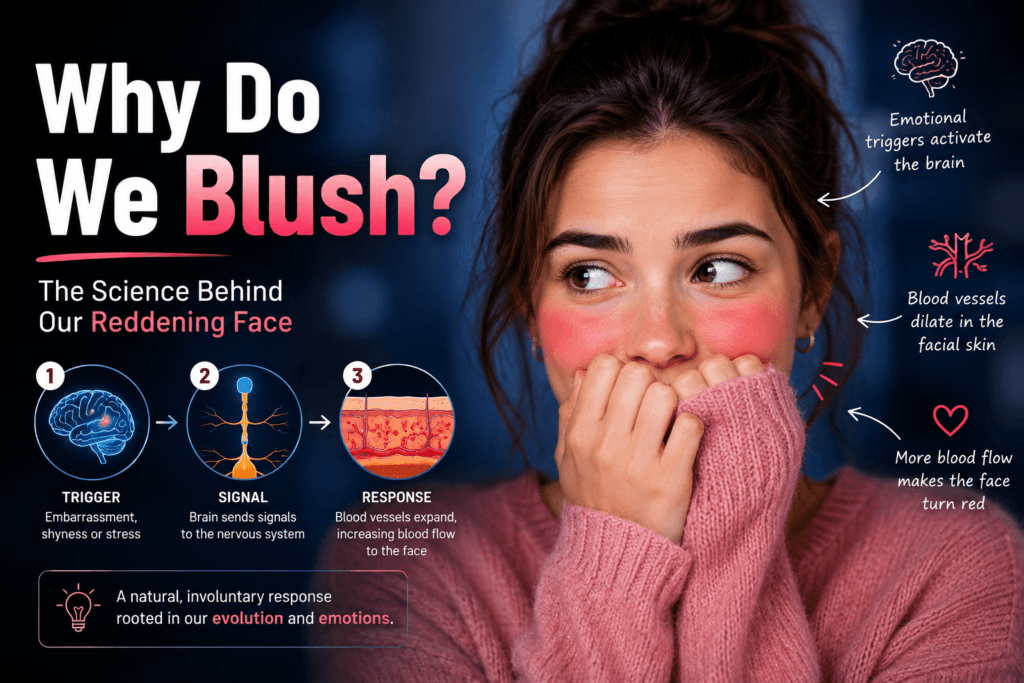
It occurs when tiny blood vessels beneath the skin widen, allowing more blood to flow through them.
The increased blood flow causes the skin to appear pink or red.
Although blushing is most noticeable on the face, it can affect other areas of the body as well.
What Causes Blushing?
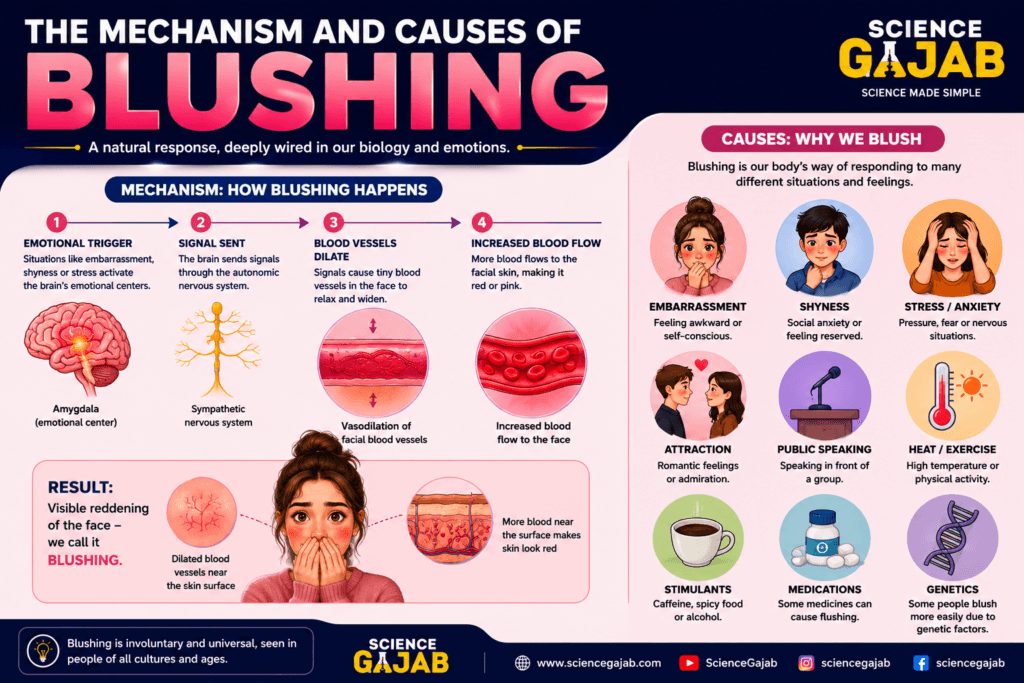
Blushing is triggered by the autonomic nervous system, which controls automatic bodily functions such as:
- Heart rate
- Breathing
- Digestion
- Blood vessel activity
When a person experiences certain emotions, the brain activates the body’s “fight-or-flight” response.
This leads to the release of adrenaline, a hormone that prepares the body to respond to important situations.
One effect of adrenaline is the widening of blood vessels in the face, causing increased blood flow and visible redness.
Why Do We Blush When Embarrassed?
Embarrassment is one of the most common triggers of blushing.
Examples include:
- Forgetting someone’s name
- Tripping in public
- Making a mistake during a presentation
- Being the center of attention
In these situations, the brain becomes highly aware of how others may perceive us.
This social awareness activates emotional centers in the brain, leading to physiological changes—including blushing.
The more self-conscious a person feels, the stronger the blush may become.
Why Do We Laugh? The Fascinating Science Behind Human Laughter
Why Do Compliments Make Us Blush?
Blushing doesn’t only happen during embarrassing moments.
People often blush when they receive:
- Compliments
- Praise
- Romantic attention
- Unexpected recognition
In these situations, the brain interprets the attention as socially significant.
The emotional response activates the nervous system, producing the familiar red-faced reaction.
Why Is Blushing Considered Uniquely Human?
Many animals show emotional reactions, but true blushing appears to be unique to humans.
The famous naturalist Charles Darwin described blushing as one of the most distinctive human expressions.
Scientists believe blushing evolved because humans are highly social creatures who depend on cooperation and communication.
Blushing may help signal:
- Honesty
- Regret
- Modesty
- Self-awareness
These signals can strengthen trust within social groups.
Parts of the Human Brain and Their Functions Explained | Science Gajab
What Happens in the Brain During Blushing?
Several brain regions become active during blushing.
Key areas include:
- The amygdala
- The prefrontal cortex
- The limbic system
These regions help process:
- Social situations
- Emotional reactions
- Self-awareness
When the brain perceives social attention or potential embarrassment, it sends signals through the autonomic nervous system that ultimately increase blood flow to the face.
Why Do Some People Blush More Easily?
Not everyone blushes with the same intensity.
Several factors influence how easily a person blushes.
Personality
People who are more socially sensitive or self-conscious may blush more frequently.
Genetics
Inherited differences in skin tone, blood vessel responsiveness, and nervous system activity can affect blushing.
Social Anxiety
Individuals with social anxiety often experience stronger blushing responses.
Skin Characteristics
Blushing tends to be more visible in people with lighter skin, although it occurs in all skin tones.
Why Does Blood Pressure Suddenly Increase? (Simple Explanation You Can Trust)
Can You Blush Just Thinking About Something?
Yes.
One fascinating aspect of blushing is that it doesn’t require an actual event.
Simply remembering an embarrassing experience can trigger a blush.
For example:
- Recalling an awkward conversation
- Thinking about a mistake from years ago
- Imagining a future social situation
The brain reacts to these thoughts similarly to how it reacts to real events, activating the same emotional pathways.
Why Does Your Face Feel Hot When You Blush?
The warmth comes from increased blood flow.
As facial blood vessels widen:
- More blood reaches the skin.
- Skin temperature rises slightly.
- A warm sensation develops.
This is why blushing often feels as noticeable as it looks.
Why Does Blushing Sometimes Make Us More Embarrassed?
Blushing can create a feedback loop.
For example:
- You become embarrassed.
- You start blushing.
- You notice the blush.
- You become more self-conscious.
- The blush intensifies.
This cycle explains why blushing sometimes seems impossible to stop once it begins.
Is Blushing a Sign of Attraction?
Sometimes.
People may blush when interacting with someone they find attractive.
Romantic interest can trigger:
- Increased emotional arousal
- Self-awareness
- Nervous excitement
These responses may activate the same pathways involved in blushing.
However, blushing alone does not necessarily indicate romantic attraction.
Can Blushing Be Controlled?
Because blushing is controlled by the autonomic nervous system, it cannot be completely controlled by willpower.
However, some strategies may reduce its intensity:
- Deep breathing
- Relaxation techniques
- Confidence-building exercises
- Managing social anxiety
- Mindfulness practices
Reducing stress and self-consciousness can lessen the likelihood of intense blushing.
What Is Fear of Blushing?
Some individuals develop a strong fear of blushing known as erythrophobia.
People with erythrophobia may:
- Avoid social situations
- Worry excessively about blushing
- Experience anxiety when speaking publicly
This fear can sometimes become more troublesome than blushing itself.
Professional support may help when blushing-related anxiety significantly affects daily life.
Interesting Facts About Blushing
- Blushing is considered uniquely human.
- It can occur due to embarrassment, praise, attraction, or attention.
- Simply imagining an embarrassing event can trigger a blush.
- The face contains numerous blood vessels close to the skin surface.
- Charles Darwin called blushing “the most peculiar and most human of all expressions.”
- Blushing often appears within seconds of an emotional trigger.
Is Blushing Bad for Your Health?
No.
Blushing is a normal physiological response.
It is not harmful and does not damage the skin or blood vessels.
In fact, researchers view blushing as a sign of healthy emotional processing and social awareness.
When Should You See a Doctor?
Blushing itself rarely requires medical attention.
However, consider consulting a healthcare professional if:
- Facial redness occurs without emotional triggers.
- Redness is persistent.
- Flushing is accompanied by other symptoms.
- Social anxiety becomes overwhelming.
Certain medical conditions can cause facial flushing that differs from normal blushing.
Frequently Asked Questions
Humans blush because emotional triggers activate the autonomic nervous system, increasing blood flow to the face.
Compliments often create self-awareness and emotional arousal, which can trigger blushing.
Not completely, but relaxation techniques and anxiety management may reduce its intensity.
Increased blood flow to facial skin causes a warm sensation
Sometimes, but blushing can occur for many reasons, including embarrassment, excitement, and social attention.
Expert Perspective
Experience
Psychologists, neuroscientists, and behavioral researchers have extensively studied blushing as part of human emotional and social behavior.
Expertise
Current evidence shows that blushing results from interactions between emotional brain centers, the autonomic nervous system, and facial blood vessels.
Authoritativeness
This article is based on established findings from psychology, neuroscience, physiology, and social behavior research.
Trustworthiness
This content is intended for educational purposes only and should not replace professional medical or psychological advice.
Final Thoughts
Blushing is one of the most fascinating and uniquely human responses. Whether triggered by embarrassment, praise, attraction, or social attention, it reflects the powerful connection between our emotions and our bodies.
Although blushing can sometimes feel uncomfortable, it serves as a natural expression of self-awareness and social sensitivity. Scientists believe it may even help build trust by signaling sincerity and emotional honesty.
The next time your cheeks suddenly turn red, remember that you’re experiencing one of humanity’s most remarkable emotional reactions—a visible sign that your brain, emotions, and body are working together in real time.
Author : Dr Sanjay Prajapati (MBBS)