
Why Do We Forget Names So Easily
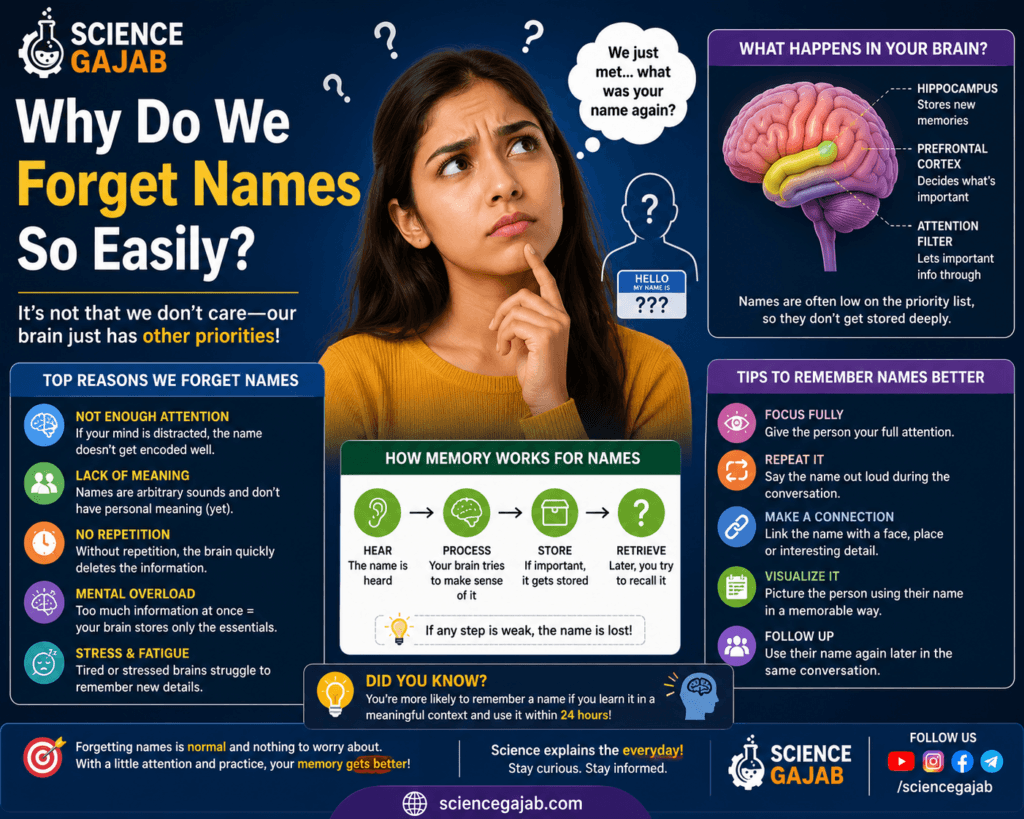
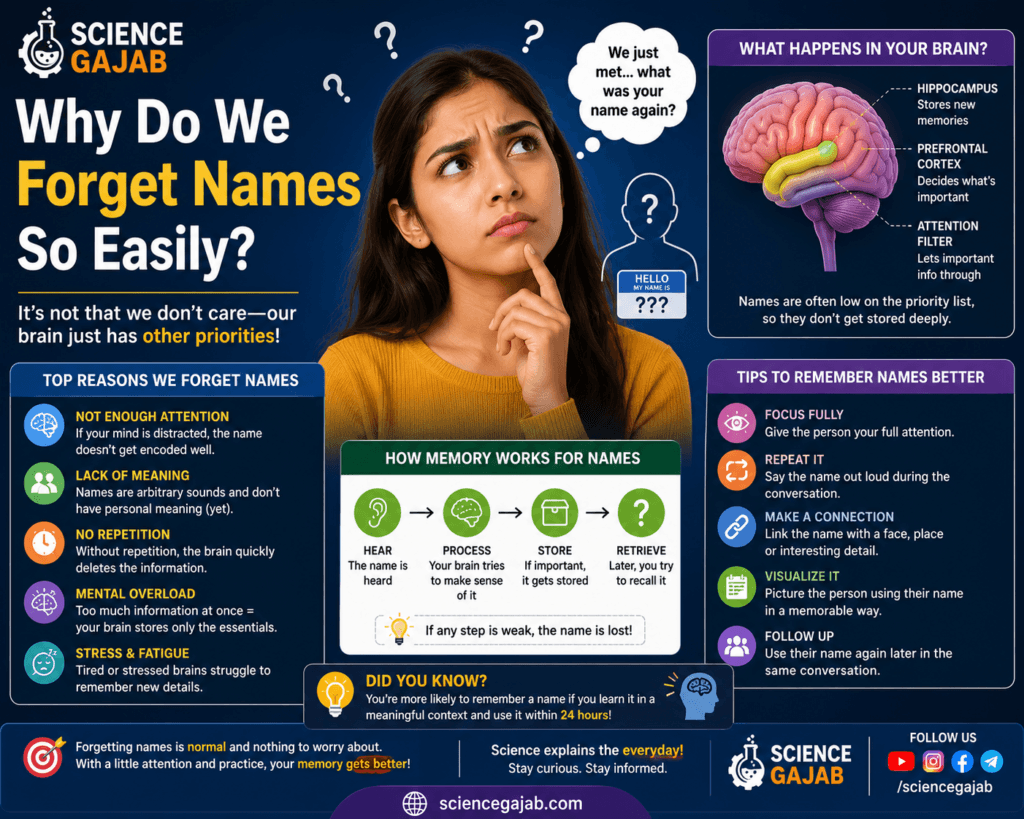
Why Do We Forget Names So Easily?
Have you ever met someone, heard their name clearly, and then completely forgotten it just minutes later? You’re not alone. Forgetting names is one of the most common memory frustrations people experience. Many of us can remember a person’s face, job, or even details about their life, yet struggle to recall their name.
This phenomenon isn’t usually a sign of poor intelligence or memory problems. Instead, it reflects how the human brain processes and stores information. Scientists have spent decades studying memory and have discovered several fascinating reasons why names are particularly difficult to remember.
Let’s explore the science behind why we forget names so easily and what you can do to improve your ability to remember them.
Why Names Are Harder to Remember Than Other Information
The brain naturally remembers information that has meaning, context, or emotional significance.
For example, if someone tells you:
- They are a doctor.
- They have three children.
- They recently traveled abroad.
Your brain can connect these facts to existing knowledge and experiences.
Names, however, are different.
Most names are simply labels. They often provide little information about a person’s appearance, personality, or background.
For example, hearing the name “Rahul” or “Sarah” doesn’t automatically tell you anything about the individual. Because names lack strong associations, the brain has fewer connections to help store and retrieve them later.
The Brain Prioritizes Faces Over Names
Humans evolved as highly social creatures.
Recognizing faces was essential for survival because it helped people identify:
- Friends
- Family members
- Allies
- Potential threats
As a result, the brain developed specialized regions for facial recognition.
One important area is the fusiform face area, which helps us quickly recognize familiar faces.
Remembering names requires different memory systems and more effortful processing. That’s why you may instantly recognize someone’s face while struggling to recall their name.
Parts of the Human Brain and Their Functions Explained | Science Gajab
We Often Don’t Pay Full Attention
One major reason people forget names is simple: they never fully encoded the name in the first place.
Imagine meeting someone at a party.
As they introduce themselves, your mind may be occupied with thoughts like:
- What should I say next?
- Do I look confident?
- How should I respond?
Because your attention is divided, the brain may fail to properly store the person’s name.
Memory experts often say:
You can’t remember what you never truly learned.
Many cases of name forgetting are actually attention problems rather than memory problems.
How Memories Are Formed in the Brain (Simple Step-by-Step Guide)
Names Usually Have Weak Mental Connections
The brain remembers information through associations.
For example:
- Fire is associated with heat.
- Chocolate is associated with sweetness.
- The ocean is associated with water.
Names often lack these natural links.
If you meet someone named David, your brain may not immediately connect that name to anything memorable.
Without strong associations, retrieval becomes difficult.
This is why memory champions often create vivid mental images linked to names when trying to remember them.
Can Brain Cells Really Regrow? The Surprising Science
The “Tip-of-the-Tongue” Effect
Have you ever known that you know a name but couldn’t recall it at that moment?
This frustrating experience is called the tip-of-the-tongue phenomenon.
During these moments:
- The memory exists.
- The brain recognizes the information.
- Retrieval temporarily fails.
You may remember:
- The first letter
- The number of syllables
- Where you met the person
Yet the actual name remains inaccessible.
Scientists believe this occurs when memory pathways are partially activated but not strongly enough to produce complete recall.
Stress Makes Name Recall Worse
Stress affects memory performance.
When you’re nervous, anxious, or under pressure, your brain releases stress hormones such as cortisol.
High stress levels can interfere with:
- Attention
- Learning
- Memory retrieval
This explains why people often forget names during:
- Job interviews
- Public events
- Business meetings
- Social gatherings
The information may be stored correctly, but stress makes accessing it more difficult.
The Science of Happiness: How Dopamine Hacks Your Brain
Age Can Affect Name Memory
Many people notice increased difficulty remembering names as they get older.
This happens because aging can slow certain memory processes.
Research suggests that older adults may experience:
- Slower retrieval speed
- Reduced working memory capacity
- More frequent tip-of-the-tongue episodes
Interestingly, older adults often retain knowledge, vocabulary, and life experiences extremely well.
The challenge is usually retrieval, not loss of intelligence.
Why Do Feet Burn at Night? Causes, Warning Signs, and When to Worry
The Brain Stores Names Differently
Memory researchers believe names are stored in a unique way compared to other facts.
Consider these examples:
Fact-Based Information
“The Eiffel Tower is in Paris.”
This information has meaning and context.
Proper Names
“His name is Michael.”
The name acts as an arbitrary label.
Because proper names have fewer connections to other stored memories, they are more vulnerable to forgetting.
Why Do You Feel Sleepy After Eating? The Real Reason Explained
Multitasking During Introductions Hurts Memory
Modern life encourages constant distractions.
When meeting someone, people often:
- Check phones
- Think about work
- Observe surroundings
- Plan responses
Even brief distractions can prevent proper memory formation.
Studies show that focused attention during learning significantly improves recall later.
Simply paying close attention during introductions can dramatically increase name retention.
Why Familiar Names Are Easier to Remember
Some names are easier to remember because they already exist within your memory network.
For example:
- A name shared by a family member
- A celebrity’s name
- A friend’s name
The brain can quickly attach the new person to an existing memory.
Unfamiliar names require building entirely new connections, making them harder to store and retrieve.
how vaccine train immune system
Sleep Plays an Important Role
Memory formation continues after learning.
During sleep, the brain strengthens and organizes newly acquired information.
Poor sleep can affect:
- Memory consolidation
- Attention
- Learning ability
People who consistently get insufficient sleep may find it harder to remember names and other details.
Quality sleep helps transform short-term memories into long-term memories.
How the Human Brain Works While You Sleep (Shocking Science)
Why We Remember Faces but Not Names
Many people experience this situation:
You see someone and instantly think:
“I know this person.”
But their name won’t come to mind.
This occurs because facial recognition and name recall rely on different brain systems.
Faces are processed through powerful visual pathways.
Names rely more heavily on language and memory retrieval networks.
As a result, facial recognition is often stronger and faster than name recall.
15 Best Foods to Improve Memory Naturally: Science-Backed Brain Nutrition
Is Forgetting Names a Sign of Memory Loss?
Usually, no.
Occasional difficulty remembering names is normal and happens to people of all ages.
However, medical evaluation may be appropriate if name forgetting occurs alongside:
- Frequent confusion
- Difficulty performing daily tasks
- Significant memory decline
- Language problems
- Disorientation
In most healthy individuals, forgetting names occasionally is simply a normal feature of human memory.
🧠 Why Does Your Brain Forget Things? The Science Will Surprise You
How to Remember Names More Easily
Fortunately, there are effective techniques for improving name memory.
1. Repeat the Name Immediately
After meeting someone, use their name naturally in conversation.
Example:
“Nice to meet you, Priya.”
Repeating the name strengthens memory encoding.
2. Create a Mental Image
Associate the name with a memorable image.
The more unusual the image, the better the brain tends to remember it.
3. Focus During Introductions
Give your full attention when someone introduces themselves.
Avoid distractions for a few seconds.
Those moments are critical for memory formation.
4. Connect the Name to Something Familiar
Link the name to:
- A friend
- A celebrity
- A family member
These associations create stronger memory pathways.
tingling due to vitamin deficiency
5. Use the Name Again Later
Repetition strengthens recall.
Using a person’s name several times during a conversation can significantly improve retention.
6. Write It Down
For professional settings, keeping notes can be helpful.
Recording names shortly after meeting someone reinforces memory.
Fun Facts About Name Memory
- Most people are better at recognizing faces than recalling names.
- The brain treats names differently from other facts.
- Stress increases the likelihood of forgetting names.
- Sleep helps strengthen name memories.
- Memory champions often rely on visual association techniques.
- Forgetting names occasionally is considered completely normal.
Frequently Asked Questions
Faces are processed by specialized brain regions, while names depend on memory retrieval systems that are generally less reliable.
Not usually. Occasional name forgetting is common in healthy people. Dementia involves broader memory and cognitive difficulties.
Most often, the brain did not fully encode the name because attention was divided during the introduction.
Yes. Techniques such as repetition, visualization, and association can significantly improve name recall.
Names are arbitrary labels with fewer meaningful connections, making them naturally harder for the brain to store and retrieve.
Final Thoughts
Forgetting names is one of the most common memory challenges humans face. The brain is excellent at recognizing faces, emotions, and meaningful information, but names often lack the context and associations needed for strong memory storage.
The good news is that occasional name forgetting is completely normal. By paying closer attention, creating mental associations, repeating names, and getting adequate sleep, you can dramatically improve your ability to remember people you meet.
The next time you struggle to recall someone’s name, remember that it’s not necessarily a sign of poor memory—it’s simply the way the human brain works.
Author Dr Sanjay Prajapati (MBBS)
🪔 May your life shine with happiness, prosperity, and success. Wishing you and your family a very Happy Diwali! ✨🎆