
Why Do Moles Appear
Why Do Moles Appear? The Science Behind Skin Moles
Moles are one of the most common skin features. Most people have 10 to 40 moles by adulthood, and the majority are harmless. However, understanding why moles appear can help you recognize normal skin changes and identify warning signs that require medical attention.
In this ScienceGajab guide, we’ll explain what moles are, why they develop, the different types, when they can become dangerous, and how doctors evaluate and treat them.
What Is a Mole?
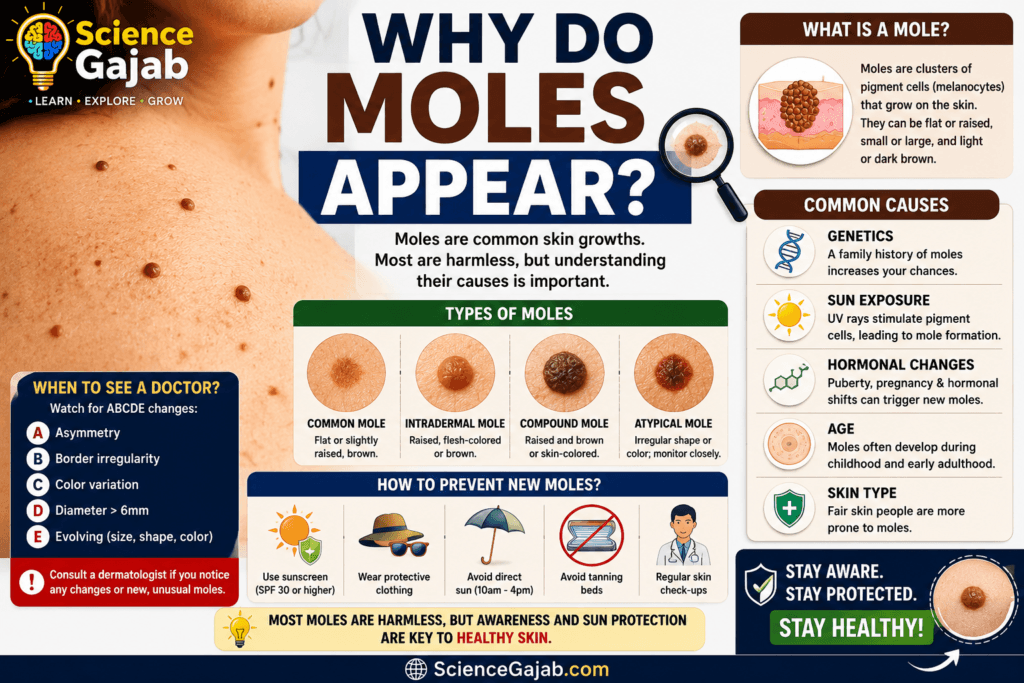
A mole (also called a nevus) is a small area of skin where pigment-producing cells, called melanocytes, grow in clusters instead of being evenly distributed throughout the skin.
Moles can be:
- Brown
- Black
- Tan
- Pink
- Flesh-colored
- Blue (rare)
They may be:
- Flat
- Raised
- Smooth
- Rough
- Hairy or hairless
Why Does Skin Become White After Fungal Infection? (Real Reason Doctors Explain)
Why Do Moles Appear?
Several factors contribute to mole formation.
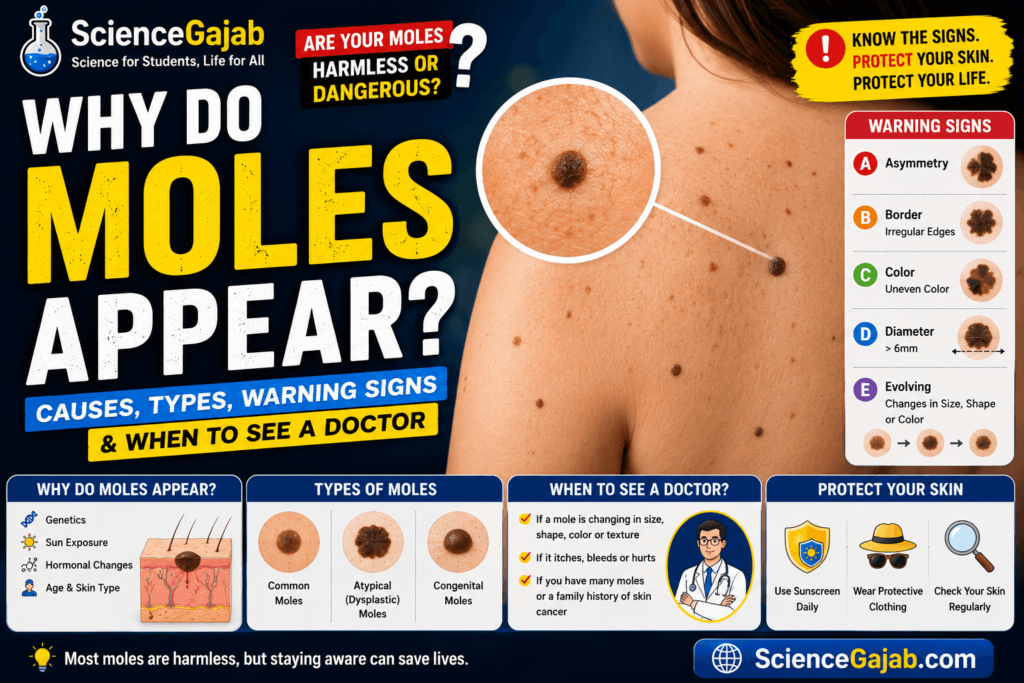
1. Clusters of Melanocytes
Normally, melanocytes are spread evenly throughout the skin. A mole forms when these cells cluster together, creating a visible pigmented spot.
2. Genetics
Your genes strongly influence:
- How many moles you develop
- Their size
- Their location
- Their appearance
People with family members who have many moles often develop more themselves.
3. Sun Exposure
Ultraviolet (UV) radiation stimulates melanocytes to produce more pigment. Excessive sun exposure, especially during childhood, may increase the number of moles and can contribute to changes in existing moles.
4. Hormonal Changes
Hormonal fluctuations during:
- Puberty
- Pregnancy
- Adolescence
may cause new moles to appear or existing moles to become darker or slightly larger.
5. Aging
Most new moles develop during childhood and early adulthood. After about age 40, it becomes less common to develop new benign moles.
Why Does Blood Pressure Suddenly Increase? (Simple Explanation You Can Trust)
Types of Moles
Common Mole (Common Nevus)
- Small
- Round or oval
- Uniform color
- Well-defined border
Usually harmless.
Congenital Mole
Present at birth.
Larger congenital moles may carry a higher lifetime risk of developing melanoma than smaller ones.
Atypical (Dysplastic) Mole
Characteristics:
- Larger than ordinary moles
- Irregular border
- Uneven color
- Different appearance from other moles
These are usually benign but may be associated with a higher risk of melanoma, especially if numerous.
Blue Nevus
A blue or blue-gray mole caused by pigment located deeper within the skin.
Spitz Nevus
Typically appears as a pink or reddish raised mole, most often in children and young adults. It can resemble melanoma and may require evaluation.
What Your Tongue Says About Your Health (Simple Guide With Tongue Signs)
Are Moles Dangerous?
Most moles are harmless.
However, some may develop into melanoma, the most serious form of skin cancer.
CANCER: NON-INFECTIOUS DISEASE:
The ABCDE Warning Signs of Melanoma
Watch for these changes:
A – Asymmetry
One half does not match the other.
B – Border
Edges become irregular, blurred, or notched.
C – Color
Multiple shades of brown, black, red, white, or blue appear.
D – Diameter
Larger than about 6 mm (roughly the size of a pencil eraser), although melanomas can be smaller.
E – Evolving
The mole changes in size, shape, color, or symptoms such as itching or bleeding.
Any evolving mole should be assessed by a healthcare professional.
How Cancer Actually Begins Inside Your Body
Symptoms That Require Medical Attention
See a doctor if a mole:
- Bleeds without injury
- Itches persistently
- Becomes painful
- Changes color
- Grows rapidly
- Develops an irregular border
- Forms a crust
- Ulcerates
- Looks very different from your other moles (“ugly duckling” sign)
🫁 Your Lungs Are Cleaning Themselves Right Now 😳 Here’s How
How Are Moles Diagnosed?
A healthcare professional may use:
Skin Examination
Visual inspection of the entire skin.
Dermoscopy
A handheld magnifying device that helps examine pigment patterns.
Skin Biopsy
If melanoma is suspected, the mole is removed or sampled and examined under a microscope.
What Happens If You Stop Drinking Water for 3 Days? (Day-by-Day Breakdown)
Can Moles Be Removed?
Yes. Moles may be removed if they:
- Are suspicious for skin cancer
- Frequently become irritated by clothing or shaving
- Cause cosmetic concerns
Removal methods include surgical excision or shave removal, depending on the type and clinical assessment.
Do not attempt to remove moles at home.
💉 How Vaccines Work (The Science Explained)
Can You Prevent New Moles?
You cannot completely prevent moles, but you can reduce UV-related skin damage by:
- Using a broad-spectrum sunscreen with SPF 30 or higher.
- Wearing protective clothing and a wide-brimmed hat.
- Seeking shade during peak sunlight hours.
- Avoiding tanning beds.
- Performing regular skin self-examinations.
🌱Difference Between Plant and Animal Cells | Simple Explanation for Students
Who Is at Higher Risk of Melanoma?
Risk factors include:
- Fair skin
- Light-colored eyes
- History of frequent sunburns
- Excessive UV exposure
- Many moles
- Atypical moles
- Family history of melanoma
- Personal history of skin cancer
- Weakened immune system
Frequently Asked Questions (FAQs)
Some adults develop new benign moles, but a brand-new or changing mole—especially after age 40—should be evaluated by a healthcare professional.
There is no strong scientific evidence that stress directly causes new moles.
Hair growth from a mole does not by itself indicate cancer. However, any concerning changes should be checked.
No. The vast majority of moles remain benign throughout life.
Yes. Some moles gradually fade or disappear over many years as part of the normal aging process.
🌿 How Plants Breathe at Night (Simple Explanation)
Key Takeaways
- Moles develop when melanocytes cluster together in the skin.
- Genetics, UV exposure, and hormonal changes all influence mole formation.
- Most moles are harmless.
- Use the ABCDE rule to monitor for warning signs of melanoma.
- Seek medical evaluation for any mole that changes, bleeds, or looks different from your other moles.
Why Trust ScienceGajab?
Medical Review Process: This article is based on current dermatology guidelines and standard medical references. It is intended for educational purposes only and should not replace professional medical advice, diagnosis, or treatment.
Author: Sanjay Prajapati (MBBS)
Reviewed by: ScienceGajab Editorial Team
Last Updated: June 2026
References
- American Academy of Dermatology – Moles and Melanoma.
- Skin Cancer Foundation – Skin Cancer Prevention.
- National Cancer Institute – Melanoma.
- Fitzpatrick’s Dermatology.
How the Internet Actually Works – Simple Explanation | ScienceGajab