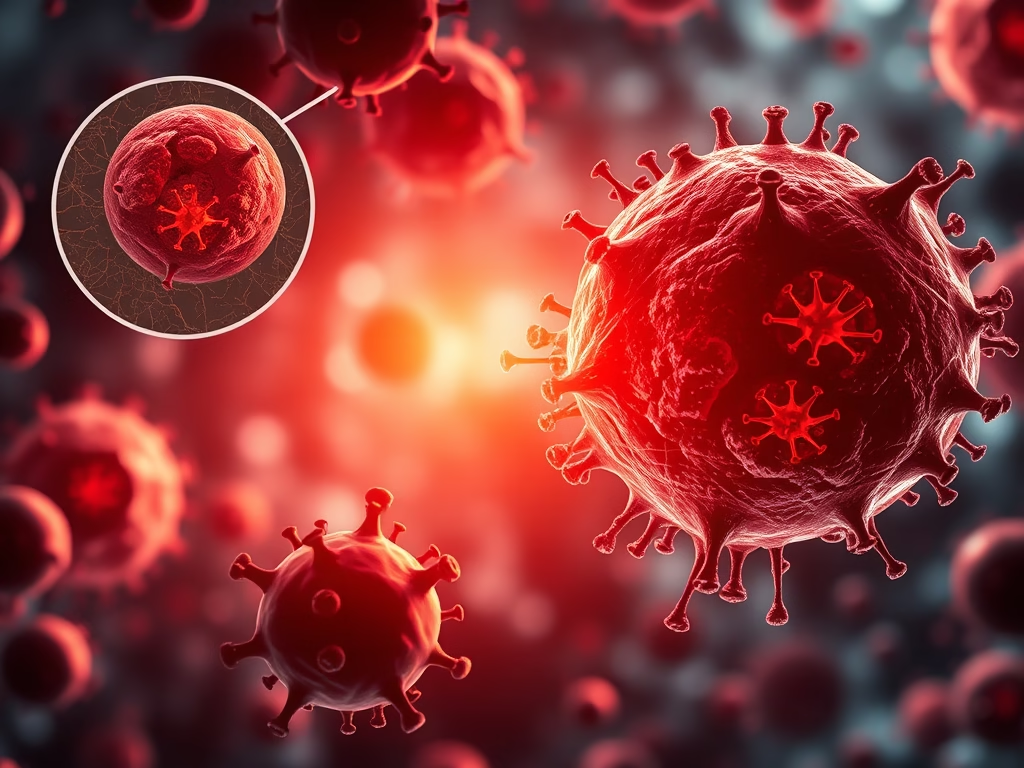

CANCER: NON-INFECTIOUS DISEASE:
Is Cancer a Non-Infectious Disease? Complete Explanation with Causes, Types, Risk Factors, and Prevention
Quick Answer
Yes, cancer is a non-infectious (non-communicable) disease because it does not spread from one person to another through direct contact, coughing, sneezing, sharing food, or physical interaction. Cancer develops when abnormal cells in the body grow uncontrollably due to genetic mutations, lifestyle factors, environmental exposures, or inherited conditions.
Although certain infections such as Human Papillomavirus (HPV), Hepatitis B Virus (HBV), Hepatitis C Virus (HCV), and Helicobacter pylori can increase the risk of developing some cancers, cancer itself is not contagious and cannot be transmitted from one person to another.
Why Is Cancer Called a Non-Infectious Disease?
A non-infectious disease is a disease that is not caused by infectious microorganisms and cannot spread from one person to another. Cancer falls into this category because it develops within the body due to abnormal changes in cells rather than being caused by a transmissible pathogen.
Unlike infectious diseases such as tuberculosis, influenza, COVID-19, or malaria, cancer cannot be caught through physical contact, air, water, food, or bodily fluids.
How Does Cancer Develop?
Cancer begins when normal cells undergo genetic mutations that disrupt their growth and division. These abnormal cells continue multiplying without control and may form tumors or invade nearby tissues.
The process generally involves:
- DNA damage or mutations
- Uncontrolled cell growth
- Formation of abnormal tissues or tumors
- Spread to other organs (metastasis)
Cancer can affect almost any organ of the body, including the lungs, breast, liver, skin, blood, brain, colon, and prostate.
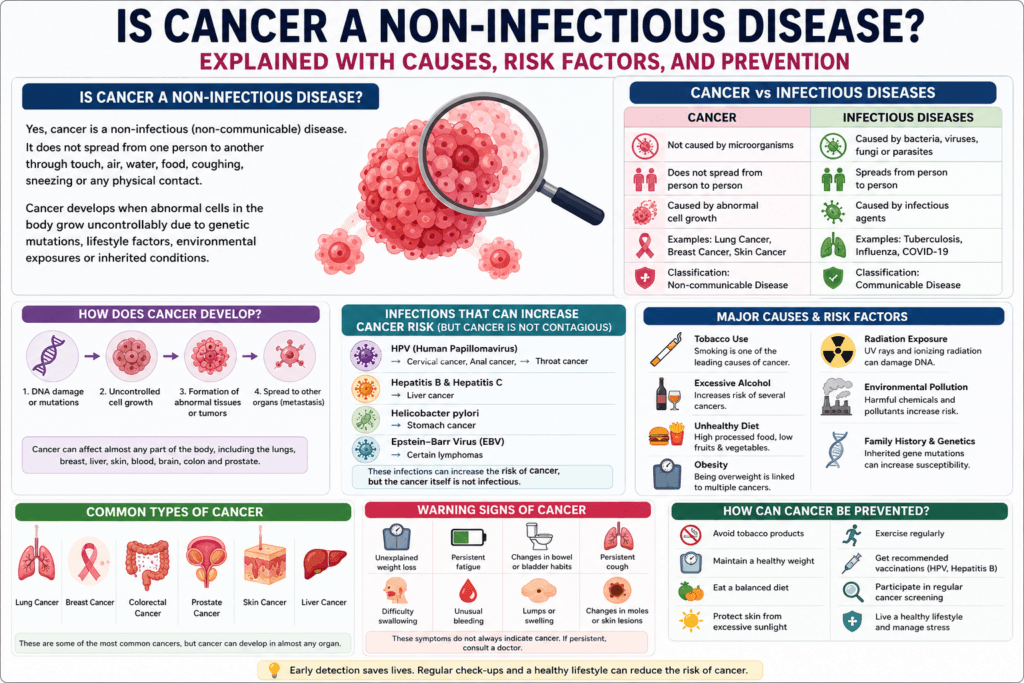
Cancer vs Infectious Diseases
| Feature | Cancer | Infectious Disease |
|---|---|---|
| Caused by microorganisms | No | Yes |
| Spreads from person to person | No | Yes |
| Caused by abnormal cell growth | Yes | No |
| Examples | Lung Cancer, Breast Cancer | Tuberculosis, Influenza |
| Classification | Non-communicable Disease | Communicable Disease |
Can Cancer Be Caused by Infections?
While cancer itself is not infectious, some infections can increase the risk of developing certain cancers.
Human Papillomavirus (HPV)
Can increase the risk of:
- Cervical cancer
- Anal cancer
- Throat cancer
Hepatitis B and Hepatitis C
Can increase the risk of:
- Liver cancer
Helicobacter pylori
Can increase the risk of:
- Stomach cancer
Epstein-Barr Virus (EBV)
Can increase the risk of:
- Certain lymphomas
However, the infection spreads—not the cancer itself.
Modes of Virus Transmission with Examples (Airborne, Vector, Contact) – Easy Guide for Students
Major Causes and Risk Factors of Cancer
Several factors can increase the risk of developing cancer:
Tobacco Use
Smoking is one of the leading causes of cancer worldwide.
Alcohol Consumption
Excessive alcohol intake increases the risk of several cancers.
Unhealthy Diet
Diets high in processed foods and low in fruits and vegetables may increase cancer risk.
Obesity
Being higher weight is linked to multiple cancer types.
Radiation Exposure
Excessive exposure to ultraviolet radiation and ionizing radiation can damage DNA.
Environmental Pollution
Exposure to harmful chemicals and pollutants may increase cancer risk.
Family History and Genetics
Certain inherited genetic mutations can increase susceptibility to cancer.
Common Types of Cancer
Lung Cancer
Often associated with smoking and air pollution.
Breast Cancer
One of the most common cancers affecting women.
Colorectal Cancer
Affects the colon or rectum and may be influenced by diet and genetics.
Prostate Cancer
Common among older men.
Skin Cancer
Frequently linked to excessive sun exposure.
Liver Cancer
Can be associated with chronic hepatitis infections.
Warning Signs of Cancer
Common symptoms may include:
- Unexplained weight loss
- Persistent fatigue
- Changes in bowel or bladder habits
- Persistent cough
- Difficulty swallowing
- Unusual bleeding
- Lumps or swelling
- Changes in moles or skin lesions
These symptoms do not always indicate cancer, but persistent symptoms should be evaluated by a healthcare professional.
How Can Cancer Be Prevented?
Although not all cancers can be prevented, the risk can be reduced by:
- Avoiding tobacco products
- Limiting alcohol consumption
- Maintaining a healthy weight
- Eating a balanced diet
- Exercising regularly
- Protecting skin from excessive sunlight
- Getting recommended vaccinations (HPV and Hepatitis B)
- Participating in cancer screening programs
Frequently Asked Questions (FAQs)
No. Cancer is a non-infectious disease and cannot spread from one person to another.
Because it develops due to abnormal cell growth rather than infection and does not spread between individuals.
No. Cancer cannot be transmitted through touching, hugging, kissing, or sharing food.
HPV, Hepatitis B, Hepatitis C, Helicobacter pylori, and Epstein-Barr Virus are examples of infections associated with increased cancer risk.
Many cancers can be prevented or their risk reduced through healthy lifestyle choices, vaccination, and regular screening.
Conclusion
Cancer is a non-infectious disease because it does not spread from one person to another. It develops when abnormal cells grow uncontrollably due to genetic, environmental, and lifestyle-related factors. While certain infections can increase the risk of cancer, the disease itself is not contagious. Understanding the causes, risk factors, symptoms, and prevention strategies can help individuals reduce their risk and improve early detection.
The Cancer is a disease in which some of the body’s cells grow uncontrollably and spread to other parts of the body.
CANCER is NON-INFECTIOUS DISEASE can start almost anywhere in the human body, which is made up of trillions of cells. Normally, human cells grow and multiply (through a process called cell division) to form new cells as the body needs them. When cells grow old or become damaged, they die, and new cells take their place.
• One of the major cause of death all over the globe.
• Cancer is uncontrol growth of cells, divide continuously and produce masses of cells called TUMOUR.
• When a normal cell comes in contact with other cells it stops division. This property is called CONTACT INHIBITION.
• Cancerous cell/oncogenic cells lost the property of contact inhibition that’s why produce tumour.
TUMORS ARE OF TWO TYPES
• Benign and Malignant
• BENIGN TUMORS
BENIGN TUMORS remain confined to their original location and do not spread and cause little damage.
• MALIGNANT TUMORS
a mass of proliferating cells called neoplastic or tumour cells. These cells grow very rapidly, invading and damaging the surrounding normal tissues.
• Cancerous cells actively divide and grow they also starve the normal cells by competing for vital nutrients.
METASTASIS:
• Cells sloughed from malignant tumour reach distant sites through blood, and wherever they get lodged in the body, they start a new tumour there and invade the most part of body.
• The most feared property of malignant tumours.
CARCINOGENS
1 • These are agent which transform the normal cells into cancerous neoplastic cells.
2 • chemical, physical or biological in nature.
3 • Chemical carcinogen e.g. tobacco smoke responsible for lung cancer.
4• Ionising radiations like X-ray & gamma rays are physical agent.
5• UV-ray à non- ionising carcinogen radiation (physical)
Cancer causing viruses called ONCOGENIC VIRUSES have genes called viral
ONCOGENES.
1 • several genes called cellular oncogenes (c-onc) or proto oncogenes have been identified in normal cells which,
2 • These genes activated under certain conditions, could lead to oncogenic transformation of the cells.
3• Oncogenes and c-onc are biological agent of cancer.
CANCER DETECTION AND DIAGNOSIS:
1 • Early detection of cancers has probability to cure.
2• Cancer detection is based on biopsy and histopathological studies of the tissue and blood.
3• In BIOPSY, a piece of the suspected tissue cut into thin sections is stained and examined under microscope (histopathological studies).
4• Bone marrow tests for increased cell counts in the case of leukaemia.• Non-invasive techniques like
1Ø Radiography (Use of X-Rays),
2Ø CT (Computed Tomography)
3Ø MRI (Magnetic Resonance Imaging) à
• very useful technique to diagnose and detect cancer.
- Antibodies against cancer-specific antigens are also used for detection of certain cancers.
Genomics in cancer àHelpful to avoid exposure to particular carcinogens to which the individual are susceptible (e.g., tobacco smoke in case of lung cancer).
CANCER Treatment:
1• Surgery,
2• radiation therapy,
3• chemotherapy and
4• immunotherapy.
In radiotherapy, tumour cells are irradiated lethally, taking proper care of the normal tissues surrounding the tumor mass.
Several chemotherapeutic drugs are used to kill cancerous cells.
1• specific for particular tumours.
2• Majority of drugs have side effects like hair loss, anaemia, etc.
3• Most cancers are treated by combination of surgery, radiotherapy and chemotherapy.
IMMUNOTHERAPY:
• Tumour cells have been shown to avoid detection and destruction by immune system. This content @sciencegajab
• Therefore, the patients are given substances called biological response modifiers such as α-interferon which activates their immune system and helps in destroying the tumour.
visit @https://www.instagram.com/sciencegajab




🤝👏🙏🌷
😍😍
Dear Sciencegajab, It’s a whole new world 🌍 which opens before our eyes when I read your posts. This post revealed many things to me. Thank you for liking my comment under Noemi 🙏🌼🌿❤️
Dear Sciencegajab, It’s a whole new world 🌍 which opens before our eyes when I read your posts. This post revealed many things to me. Thank you for liking my comment under one of the beautiful posts of Ms Noemi 🙏🌼🌿❤️
Dear Gajab Ji,
Thanks for liking my comment under Noemi 🥰🙏