
🫀 Visual Overview (Easy Diagram)
📌 Introduction
Your body runs on an incredibly efficient transport system—the circulatory system. At its core are three types of blood vessels:
- Arteries
- Veins
- Capillaries
Among these, arteries and veins are the major highways that carry blood throughout the body. Understanding their differences is essential not only for exams (MBBS, NEET-PG) but also for clinical reasoning in everyday medicine.
In this article, you’ll learn the difference between arteries and veins with clear concepts, diagrams, tables, and clinical relevance—all explained in simple, human language.
Structure and Function of the Human Heart | Circulatory System Explained
🧠 Basic Concept (In 60 Seconds)
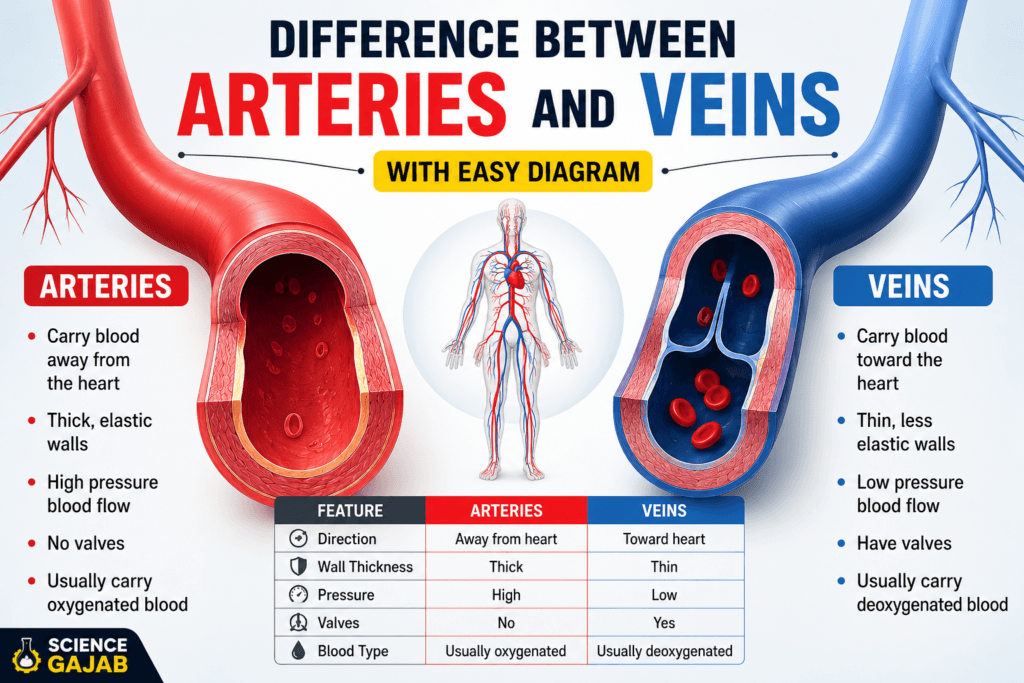
- Arteries carry blood away from the heart
- Veins carry blood towards the heart
👉 That’s the most important rule.
But there are exceptions (which we’ll cover later).
🫀 Human Circulatory System Basics: A Complete Guide
🫀 What Are Arteries?
Definition:
Arteries are blood vessels that carry blood from the heart to body tissues.
🔬 Key Features:
- Thick, elastic walls
- High pressure blood flow
- Usually carry oxygenated blood
- No valves (except near heart)
💡 Example:
- Aorta (largest artery)
- Coronary arteries
🫀 What Are Veins?
Definition:
Veins are blood vessels that carry blood from tissues back to the heart.
🔬 Key Features:
- Thin walls
- Low pressure
- Carry deoxygenated blood (mostly)
- Have valves to prevent backflow
💡 Example:
- Superior vena cava
- Inferior vena cava
⚖️ Arteries vs Veins (Quick Comparison Table)
| Feature | Arteries | Veins |
|---|---|---|
| Direction | Away from heart | Towards heart |
| Blood type | Oxygenated (mostly) | Deoxygenated (mostly) |
| Wall thickness | Thick | Thin |
| Pressure | High | Low |
| Lumen | Narrow | Wide |
| Valves | Absent | Present |
| Pulse | Present | Absent |
🔍 Structural Differences (MBBS-Level Understanding)
1. Tunica Layers (Histology)
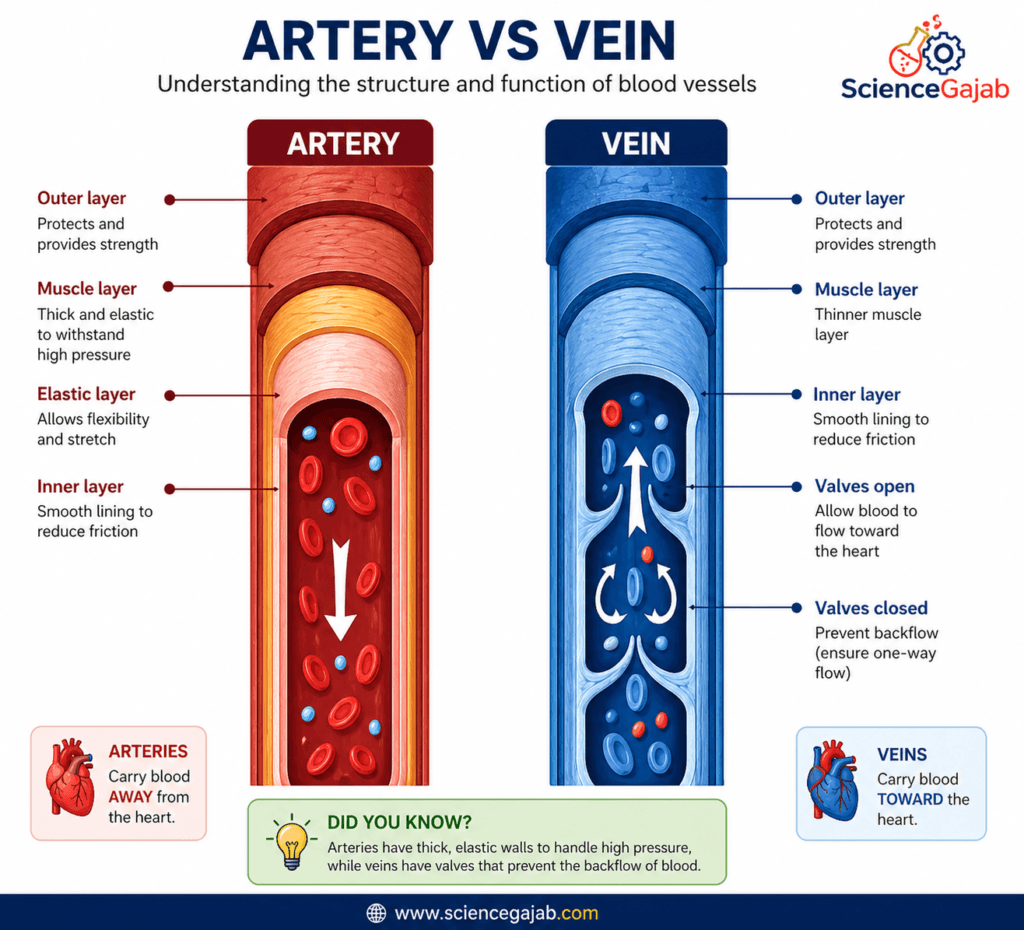
Both arteries and veins have 3 layers:
- Tunica Intima
- Tunica Media
- Tunica Adventitia
🟥 Arteries:
- Thick tunica media
- Rich in elastic fibers
- Helps withstand high pressure
🟦 Veins:
- Thin tunica media
- Thick adventitia
- Less elastic tissue
👉 Clinical note:
Arteries can maintain shape, veins collapse easily.
2. Lumen Size
- Arteries → Narrow lumen
- Veins → Wide lumen
👉 This affects blood flow dynamics.
3. Presence of Valves
- Arteries → ❌ No valves
- Veins → ✅ Valves present
👉 Prevents backflow, especially in legs.
🔄 Blood Flow Dynamics
🟥 Arterial Flow:
- Fast
- Pulsatile
- High pressure
🟦 Venous Flow:
- Slow
- Non-pulsatile
- Depends on:
- Muscle contraction
- Breathing
👉 This is called the muscle pump mechanism
⚠️ Important Exceptions (VERY IMPORTANT)
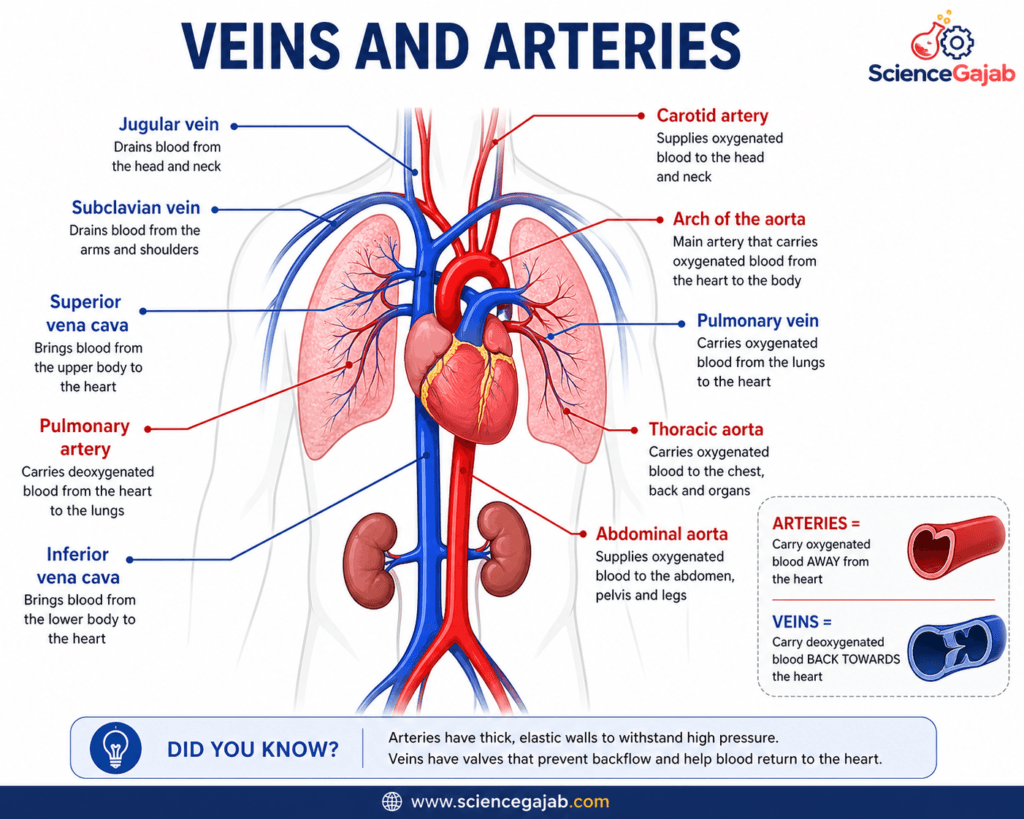
❗ 1. Pulmonary Artery
- Carries deoxygenated blood
- From heart → lungs
❗ 2. Pulmonary Vein
- Carries oxygenated blood
- From lungs → heart
👉 These reverse the usual rule.
Why Veins Look Blue But Blood Is Always Red
🧬 Clinical Importance (MBBS Focus)
🩺 1. Blood Pressure Measurement
- Measured in arteries
- Because of high pressure
🩺 2. IV Injection
- Given in veins
- Because:
- Easy access
- Low pressure
🩸 What Happens When You Transfuse Blood to a Normal Person?
🩺 3. Arterial Bleeding vs Venous Bleeding
| Type | Appearance |
|---|---|
| Arterial | Bright red, spurting |
| Venous | Dark red, steady flow |
👉 Important in trauma cases.
🩺 4. Varicose Veins
Cause: Valve failure in veins
Effect: Blood pooling
👉 Common in legs.
🩺 5. Atherosclerosis (Arteries)
- Fat deposition in arteries
- Leads to:
- Heart attack
- Stroke
Your Heart Can Stop in Minutes — Here’s How Artery Blockage Happens
🔬 Types of Arteries
- Elastic arteries (e.g., Aorta)
- Muscular arteries
- Arterioles
🔬 Types of Veins
- Superficial veins
- Deep veins
- Venules
🧠 Easy Memory Tricks
🟥 Artery = Away
👉 A → Away from heart
🟦 Vein = Return
👉 Veins bring blood back
🔄 Role in Circulation
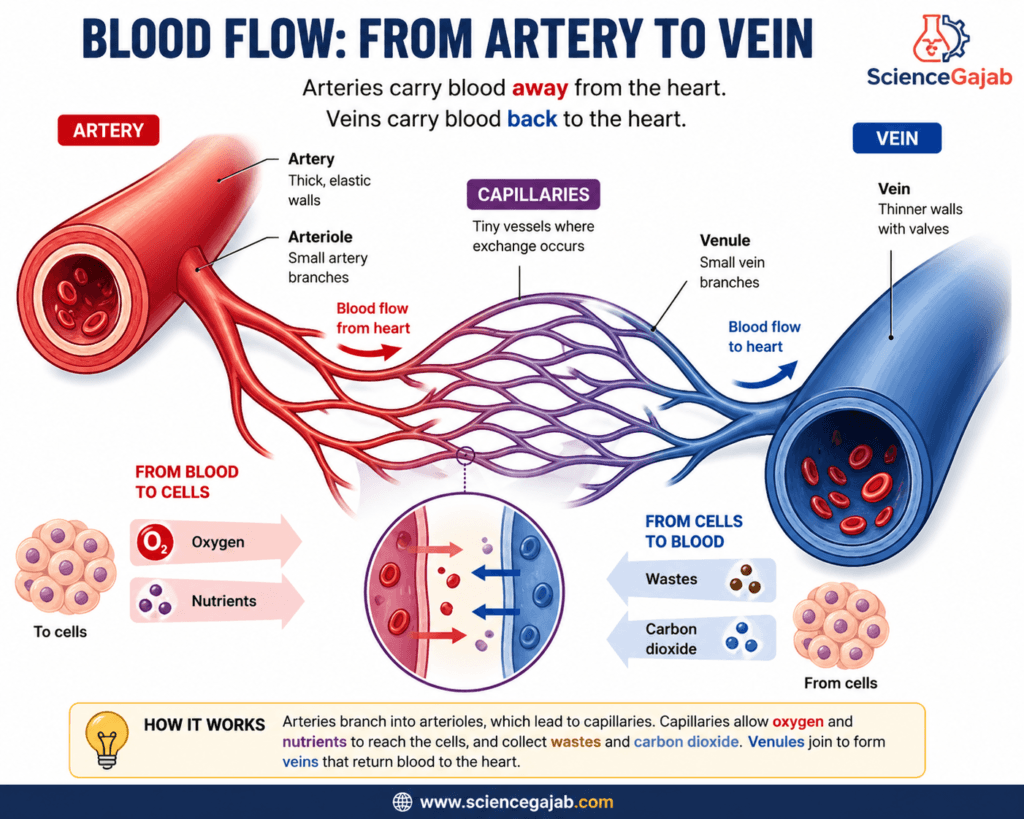
Flow pathway:
Heart → Arteries → Arterioles → Capillaries → Venules → Veins → Heart
👉 This is the complete circulation loop
❤️ What Happens During a Heart Attack? The Science Explained
📊 Summary Table (High-Yield)
| Feature | Artery | Vein |
|---|---|---|
| Function | Carry blood away | Return blood |
| Oxygen level | High | Low |
| Wall | Thick | Thin |
| Valves | No | Yes |
| Pressure | High | Low |
🎯 Final Conclusion
- Arteries and veins are both essential for survival
- They differ in structure, function, and pressure handling
- Understanding them helps in:
- Clinical diagnosis
- Emergency medicine
- Basic physiology
👉 If you remember just one thing:
Arteries = Away from heart
Veins = Towards heart
Your Heart Beats 100,000 Times a Day—But Never Gets Tired. Here’s Why
💬 Engage With Us (ScienceGajab)
Did this article help you understand clearly?
👉 Comment “YES” if it helped
👉 Share with someone
🔎 facebook.com/sciencegajab/
Medical Disclaimer: This article is for educational purposes only and does not replace professional medical advice. Information has been reviewed using trusted medical and anatomy resources including Cleveland Clinic, NCBI, MedlinePlus, and Britannica.
Must Read our Editorial Policy
🧠 Blood Supply of the Brain: The Hidden Network That Keeps You Alive (Explained Simply!)